Firmographic and Technographic Data Providers for ICP Definition
Firmographics must anchor your ICP before layering technographics and intent signals.

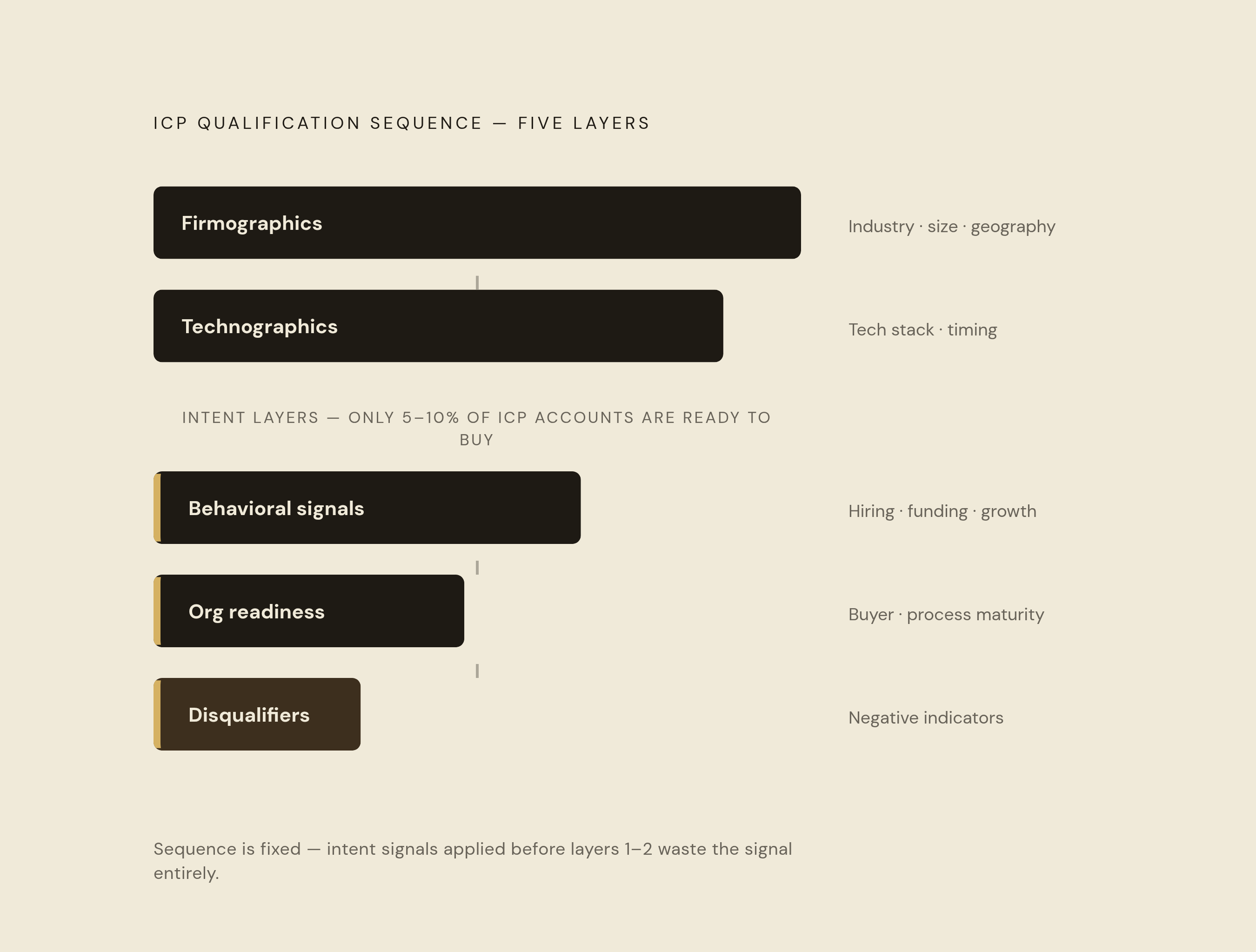
A complete ICP is built in five layers, with firmographic and technographic data sitting at different points in that sequence rather than side by side as interchangeable options. Firmographics establish whether an account is a fit at all: industry, size, geography. Technographics take that group of fitting accounts and narrow it further, sorting out which ones are operationally compatible and actually ready to buy. Behind those sit behavioral signals like hiring, funding, and growth, organizational readiness (who the buyer is and how mature their process looks), and negative indicators that can disqualify an account even after it clears everything else.
The order matters because each layer depends on the one before it holding up. Firmographics answer "is this account a fit?" Technographics answer whether the account is a technical match and whether the timing is right. Clay's framing treats firmographic data as the foundation layer that has to be resolved before intent data means anything at all. Skipping that resolution means a team ends up scoring intent signals on accounts that never should have made the list.
Most teams never get past step one. The Landbase framework identifies a common ICP mistake: building an ICP on firmographics alone and treating technographic, behavioral, and signal data as optional add-ons rather than required layers. That shortcut produces an ICP that looks complete on a slide but tells a sales team almost nothing about which of the "fit" accounts are worth calling this week.
Why firmographic data is harder to get right
Firmographic data has a credibility problem it doesn't advertise. It sits in the CRM looking authoritative, formatted, filterable, seemingly verified, but it's the least accurate data most teams own, because most of it comes from inference rather than direct verification. Even the strongest providers top out in the mid-80s on accuracy for firmographic fields, while contact email verification clears meaningfully higher thresholds. That gap between how confident the data looks and how confident it should be is where a lot of downstream scoring errors start.
Cleanlist found that job title changes affect a substantial share of tracked individuals within twelve months, compounding inference errors, and email addresses decay too, though at a meaningfully slower annual pace across a typical B2B database. A one-time enrichment pass is stale within months, not years. And the two fields most GTM teams filter on hardest, revenue and employee count, are exactly the fields most likely to be inferred rather than verified, and least frequently re-checked by providers once they're on file.
There's a structural amplifier here too. Get a parent account's industry classification wrong, and every child account underneath it inherits that same error, so one bad data point spreads across an entire hierarchy of records. The practical fix isn't chasing bigger databases. HG Insights' use-case guide identifies match rate against a team's actual account list, not raw database size, as the evaluation criterion that predicts real performance. A smaller database that matches a high share of a team's specific ICP accounts beats a larger one that matches fewer of them.
Where technographic data adds precision that firmographics cannot provide
Firmographic filters alone can't tell a team which accounts close inside a month and which ones evaluate for half a year and vanish. Technographic data, layered on top of firmographic filters, is what makes that distinction possible. ZoomInfo's technographic data guide notes it answers three questions firmographics simply can't touch: what the prospect already runs, where the gaps sit in that stack, and whether a given product could displace something already installed.
Tech stack composition signals operational maturity and shows where integration work will be heavy or light. It also flags where a competitive displacement play makes sense. The Landbase ICP framework holds that a company running Salesforce alongside Outreach occupies a different buying posture than one running HubSpot with no sales engagement tool at all. Two firms can share identical revenue and headcount and still sit on opposite ends of that spectrum. Firmographics would score them the same; technographics wouldn't.
Depth and recency separate a technographic dataset worth paying for from one that just adds noise. Install dates, contract renewal windows, and stack-replacement events turn a static list of tools into something a team can act on with timing. ZoomInfo's own evaluation criteria hold that a plain list of technologies helps with filtering, while a dataset carrying adoption timing helps with prioritization.
Technographic fit also does something intent data can't: it holds still. Firmographic and technographic fit stays stable week to week, gets scored once, and updates only when new information comes in. Intent behaves the opposite way, spiking and decaying fast, and at any given moment only an estimated five to ten percent of ICP accounts are actually ready to buy. Technographic fit is the stable scaffolding; intent is the weather moving across it.
How the market has fractured into four data types
HG Insights' use-case guide found the B2B data category has split into four distinct types, contact, firmographic, technographic, and intent, and a platform that leads on one of them often underperforms on the rest, and this structural fracture drives both vendor specialization and multi-provider stacking.
Aggregate coverage numbers hide thin spots. A vendor can claim broad coverage while its data matches only a fraction of the ICP accounts a specific team actually cares about. HG Insights' use-case guide found vendor coverage matching only around 40 percent of the ICPs vendors claim to cover, turning into six-figure contracts against data that degrades faster than teams can put it to use. Geography compounds the problem: US-centric providers show substantially lower match rates and accuracy outside North America, so for any company running meaningful EMEA or APAC pipeline, geographic coverage accuracy has to be a primary filter in vendor selection, not something checked after the fact.
Two evaluation criteria predict real-world return and vendors tend not to volunteer either one. Match rate against the team's own account list, not database size, is the first. HG Insights identifies data freshness measured by re-verification frequency, not a compliance page listing when the database was "last updated," as the second. There's a practical test that cuts through vendor marketing entirely: ask a vendor to run a pre-sale match test against a masked version of the team's existing account list. A reputable provider does this at no charge. A vendor that declines, or answers with aggregate database statistics instead of a real match rate, is telling a team something about the quality of its data without saying it outright.
Firmographic-first providers: what each covers, where each thins out
Choosing a firmographic provider depends heavily on where an ICP sits in the account hierarchy, since coverage thins out differently at enterprise, mid-market, and SMB tiers. There's no single provider that covers all three equally well, so the right starting point is the tier a team actually sells into.
ZoomInfo operates as the category's dominant integrated platform, tracking more than 30,000 technologies across a vast universe of companies, with built-in phone numbers, technographic and intent data, and sales automation bundled into one system. Its GTM Context Graph processes billions of data points daily, and the platform is built for outbound sales teams running high-volume prospecting who want one place to find, filter, and reach contacts. Sisense combined ZoomInfo CRM enrichment with its account-based marketing motion and reached a high level of data accuracy as a result, a documented case that shows what depth-first firmographic enrichment looks like in practice.
Clearbit, now Breeze Intelligence inside HubSpot, offers company and contact enrichment across more than 40 data attributes, covering firmographic, technographic, and demographic data. Since the HubSpot acquisition, standalone API access outside the HubSpot ecosystem is being phased out, which makes Breeze Intelligence most relevant to teams already living inside HubSpot, where it fills form fields, shortens signup flows, and flags in-market companies without forcing a rep to leave the CRM.
Landbase covers a B2B database of hundreds of millions of contacts with thousands of enrichment fields, and it pairs that with agentic search for building audiences from plain-language queries, AI qualification that scores accounts automatically, and lookalike modeling to surface companies similar to existing best customers. It fits teams that want enrichment, qualification, and signal detection handled inside a single workflow surface rather than stitched together across separate tools.
Dun & Bradstreet holds a distinct position as the firmographic authority for corporate hierarchy data specifically, the parent-subsidiary relationships and account hierarchy modeling where a classification error at the parent level cascades down into every child account beneath it.
Technographic-first providers: where depth of stack intelligence matters most
When an ICP calls for enterprise IT spend intelligence or contract renewal targeting, technographic specialists outperform the integrated platforms on depth of coverage at the accounts that matter most. Breadth and depth pull in different directions here, and no single vendor optimizes for both at the enterprise tier.
HG Insights is the specialist built for that depth. The HG Platform delivers technology spend intelligence and contract renewal timing, with coverage concentrated on the largest enterprise accounts, making it the strongest option when the use case is enterprise IT spend forecasting or renewal targeting. HG Insights' blog states that in June 2025, HG Insights acquired TrustRadius, folding review-based intent data together with its existing technographic and market intelligence. The tradeoff appears below that tier: coverage thins out under the Fortune 5000, and the platform carries no native contact graph, intent layer, or workflow automation surface of its own.
ZoomInfo tracks more than 30,000 technologies across upward of 148 categories over a large universe of companies, giving it broader category coverage than HG Insights, though with less depth on enterprise spend and renewal timing specifically. Its real advantage is architectural: technographic data sits embedded alongside contact data and intent signals in the same platform, so a rep isn't stitching together three separate exports.
6sense collects its technographic data in-house, covering tens of thousands of technologies across 148 industries, and anchors the enterprise ABM segment. Plans reportedly start at a significant annual investment for mid-market teams and scale into six figures for enterprise deployments. Its intent layer needs scale to earn its cost: it performs best tracking thousands of accounts, and adds much less value against a tightly bounded list of already-known target accounts.
BuiltWith rounds out the technographic tier as a source used inside Clay enrichment workflows specifically, particularly for detecting web technology stacks across accounts.
Intent data as the third layer, with Bombora and 6sense in that stack
Intent is the most volatile of the three layers and belongs last in the sequence, not first. At any given moment, only an estimated five to ten percent of ICP accounts are actually ready to buy, so intent data works best as a prioritization filter applied to a list that's already been narrowed by firmographic and technographic fit. Running it earlier means a team ends up chasing spikes on accounts that were never going to be a fit anyway.
Bombora functions as the intent cooperative benchmark for the category. It aggregates research behavior across a publisher network and sits upstream of the intent signals that surface inside several downstream platforms. That upstream position carries a practical implication: buying Bombora intent through a reseller delivers the same underlying signal as buying it directly from Bombora itself, so real differentiation between vendors comes from contact data quality and workflow integration, not from the intent signal itself.
6sense's intent layer is built for scale and performs best tracking thousands of accounts at once. Fit and intent are separate disciplines and should be scored separately: fit is stable, scored once, and updated as new information arrives; intent spikes and decays by design and needs continuous tracking rather than a one-time scorec12.
Waterfall enrichment and Clay as an orchestration layer above individual providers
Outbound Kitchen's findings show that since no single provider wins every layer, most operating teams have settled on waterfall enrichment as the baseline practice: querying multiple providers in sequence and keeping the first verified match, with each additional source lifting the overall match rate by a smaller amount than the one before it.
Clay has positioned itself as an orchestration layer sitting above individual data providers rather than as a data provider in its own right. It pulls enrichment from multiple sources, with Clearbit, BuiltWith, and HG Insights serving as primary firmographic and technographic inputs, and pairs that with AI-driven personalization and workflow automation. That structure supports a workflow where 6sense identifies high-intent accounts and Clay handles enrichment and personalization at the contact level. Clay's own analysis found that combining multiple data providers this way achieves 3x the enrichment rate of relying on a single source. Clay's built-in AI agent, Claygent, sits between enrichment and the destination system, and documented uses include scraping a prospect's homepage to pull out a value proposition, turning funding announcements into personalization hooks, and classifying a company into an ICP tier straight from its website copy.
The objection to stacking this many tools is legitimate. Sales reps at large companies already juggle ZoomInfo, Sales Navigator, Salesforce, Clay, and Demandbase, none of which integrate cleanly with each other, and bolting on another layer can make that sprawl worse rather than better. Orchestration earns its keep only when a team has decided, before adding a new tool, exactly which data layer that tool is responsible for. Stacking itself was never the problem: deciding in advance which provider answers which ICP question is.
Matching a provider to the ICP layer you are trying to fill
Evaluating a provider comes down to which ICP layer needs filling, and which provider has the deepest, freshest coverage at the specific account tier that matters for the deal in front of the team.
For firmographic foundation work at high-volume outbound scale, ZoomInfo's integrated platform or Landbase's agentic enrichment and qualification surface both fit the job. For teams running entirely inside HubSpot, Breeze Intelligence, the former Clearbit, handles firmographic enrichment natively, with the caveat that standalone API access outside HubSpot is being phased out. For enterprise technographic depth and contract renewal timing specifically, HG Insights covers the Fortune 5000 tier better than any integrated platform, though it needs to be paired with a separate contact-data source for outreach, since it carries no native contact graph of its own.
None of these providers replace the sequence itself. Firmographics still answer whether an account is a fit before anything else gets evaluated. Technographics still narrow that fitting group down to who's operationally ready. Intent still comes last, applied only once fit has already been established. The providers change depending on tier and use case. The order they answer questions in doesn't.
Sources
- Top 10 B2B Technographic Data Providers for 2026
- B2B Data Providers in 2026: Use-Case Guide | HG Insights
- How to Define Your ICP in 2026: A Step-by-Step Framework for B2B Teams | Landbase
- What Is Firmographic Data? Definition, Examples, and Uses for 2026 | Clay
- Technographic Data: The Complete B2B Guide for 2026