Why Your Email Domain Gets Flagged and How to Fix It
Prevent your emails from landing in spam by fixing authentication and reputation issues first.
Why Your Email Domain Gets Flagged and How to Fix It.
Why nearly 1 in 6 marketing emails never reach the inbox
EmailTooltester's 2026 deliverability data shows 16.9% of all emails never reach the intended inbox: 10.5% land in spam, and 6.4% go undelivered entirely EmailTooltester 2026 deliverability data skrapp.io. Validity's Email Deliverability Benchmark Report puts the average global inbox placement rate at 87.2% for 2025, an improvement of 3.7 percentage points over the prior year, but that number is the floor, not something to aim for Validity 2026 Email Deliverability Benchmark Report Unspam.email annual deliverability report skrapp.io. Unspam.email's 2025 annual report makes the gap even starker: a Global Deliverability Health Score of 87 out of 100 sounds solid, yet only 66% of emails actually reached a visible mailbox location, meaning technical delivery overstates real inbox reach by about 34% Unspam.email annual deliverability report.
None of this happens in a vacuum, either. Gmail alone commands 42.9% of the global mailbox market, and Google, Microsoft, Yahoo, and Apple together handle around 77% of all email traffic agilebrandguide.com EmailTooltester 2026 deliverability data. So whatever these four companies decide about a domain is, in effect, the market's final verdict on it agilebrandguide.com EmailTooltester 2026 deliverability data. There's no appeals process beyond understanding what triggered the decision and fixing it layer by layer. Powerdmarc.com, the Unspam.email 2026 statistics, the EasyDMARC 2026 Adoption Report, and skrapp.io show that the 95%–99% range is what a healthy deliverability rate looks like, while below 94% signals active problems with reputation, authentication, or list hygiene.
How spam filters make the inbox-or-spam decision
Spam filters don't work off a single rule or blocklist. They run as layered systems that weigh sender identity, sending behavior, message content, and recipient engagement all at once, and they arrive at an inbox-or-spam verdict by combining all of it.
Those three layers are not weighted equally. Reputation and authentication dominate the decision; content signals matter, but they sit lower on the scale, a medium input at best. That ordering matters because most senders instinctively reach for content fixes first, tightening subject lines or swapping words, when the actual flag came from somewhere further upstream.
Google, Yahoo, and Microsoft each run independent filtering systems, but their requirements have been converging fast agilebrandguide.com EmailTooltester 2026 deliverability data. Google and Yahoo rolled out mandatory new rules starting in February 2024, and Microsoft followed with tighter Outlook filtering in 2025. None of this is static, either: filters retrain continuously against real user behavior, and providers share intelligence with each other across networks, so a sending pattern that worked cleanly two years ago can actively hurt a domain today.
A flag is almost always caused by the compounding of several weak signals stacked on top of each other. It's the compounding of several weak signals stacked on top of each other. That's exactly why fixing content alone, without touching authentication or reputation, tends to fail. The rest of this piece works through those layers in the order they actually need fixing: authentication first, then reputation, then list hygiene, then content. Content signals include links, HTML structure, subject line language, image-to-text ratio, and attachment types.
Authentication gaps: what SPF, DKIM, and DMARC do
Missing or misconfigured authentication remains the single biggest reason legitimate email gets flagged, and multiple 2026 sources converge on that same point. SPF is a DNS record listing which servers are allowed to send mail on a domain's behalf, and receiving providers check the origin IP of incoming mail against that list. DKIM attaches a cryptographic signature to every outgoing message, verified by the receiving server against a public key published in the sender's DNS, confirming the message wasn't tampered with in transit. DMARC sits above both of these as a policy layer: it ties SPF and DKIM results to the visible From: address the recipient actually sees, and it tells receiving providers what to do when something fails, whether to monitor it (p=none), quarantine it, or reject it outright.
The part senders most often get wrong is alignment. Passing SPF or DKIM isn't enough on its own; the domain that authenticated has to match the domain shown in the From: field the recipient reads. Skip that, and a domain becomes an open target: someone else can spoof it in a phishing or spam run, and the domain owner ends up blacklisted for messages they never sent.
Adoption numbers for 2026 show a lopsided picture EmailTooltester 2026 deliverability data skrapp.io. SPF is 93%, DKIM is 90%, reverse DNS is 99%, all fairly mature Unspam.email 2026 statistics. DMARC, though, is stuck at 64%: more than a third of sending domains have no DMARC policy published at all Unspam.email 2026 statistics. That gap alone explains a meaningful share of the flagging problem industry-wide. But adoption alone doesn't account for the deeper issue. Even among domains that do have DMARC set up, most of them have it configured in a way that offers no real protection.
Why DMARC at p=none is almost as dangerous as no DMARC at all
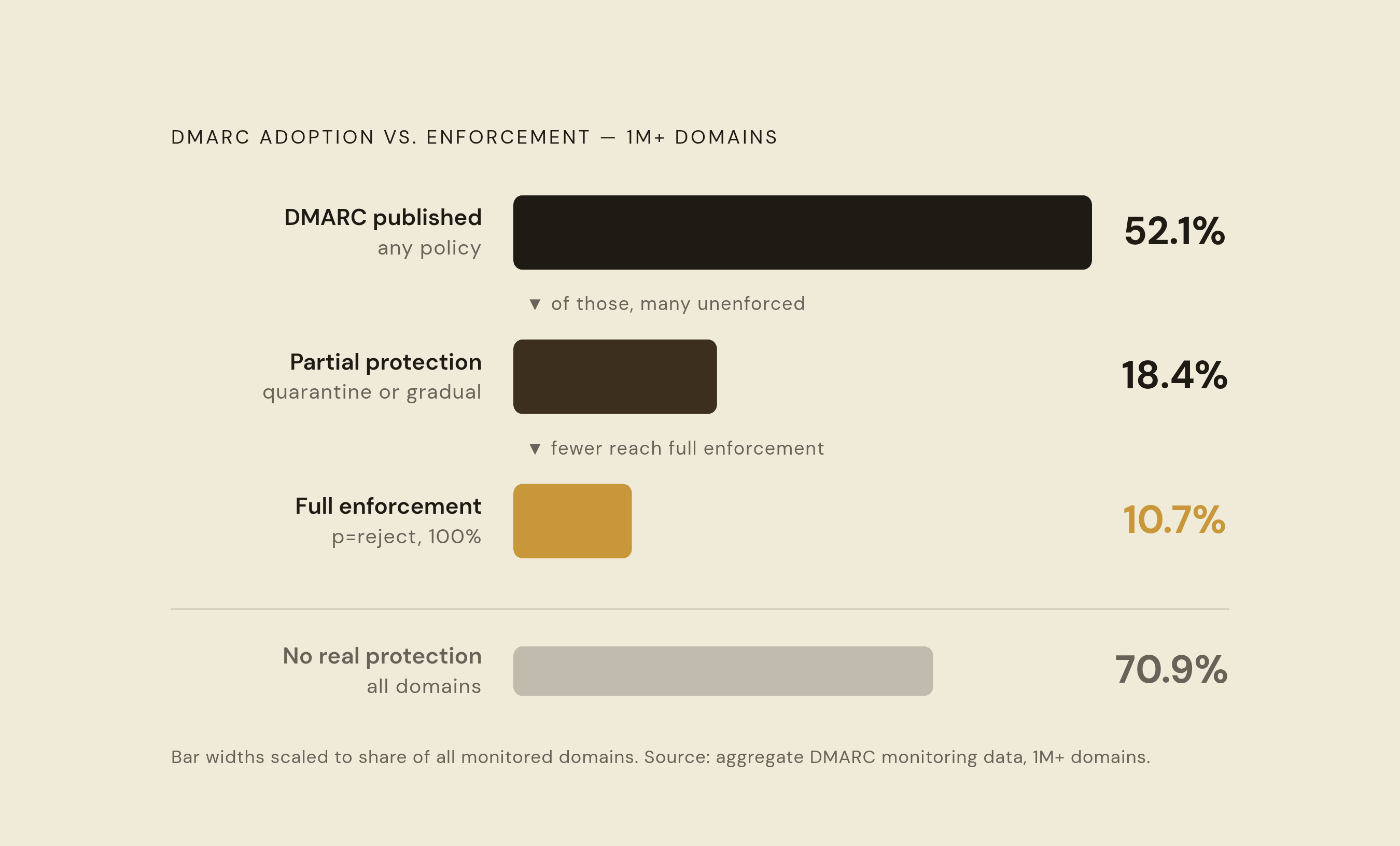
EasyDMARC's Adoption Report puts global DMARC adoption at 52.1%, up sharply from 27.2% in 2023 EasyDMARC 2026 Adoption Report skrapp.io. More than half of those domains sit at p=none, a mode that monitors traffic and generates reports but takes no action when authentication fails, so the reported adoption gains overstate the real protection in place EasyDMARC 2026 Adoption Report skrapp.io. Broader monitoring across more than a million domains as of March 2026 found only 10.7% running full protection at p=reject with 100% enforcement, 18.4% at partial protection through quarantine or a gradual rollout, and 70.9% with no effective DMARC protection at all getmailbird.com.
The gap between large and small organizations is stark. Fortune 500 companies show 95% DMARC adoption, with 62.7% already at p=reject⟧c24⟧ powerdmarc.com EasyDMARC 2026 Adoption Report skrapp.io. Inc. 5000 companies lag well behind: 76.2% adoption, but only 15.2% at p=reject EasyDMARC 2026 Adoption Report skrapp.io. Most small and mid-sized senders fall into that unprotected majority, running DMARC in name only.
What p=none actually buys a domain owner is visibility. Reports come in showing what's failing, but providers aren't told to block or quarantine anything, so a spoofed campaign can run freely under the domain's name while the reputation damage lands on the real owner. The correct sequence is to start at p=none deliberately, using it to collect data and confirm every legitimate sending source is accounted for, then move to p=quarantine once confident in that coverage, and finally to p=reject. Google and Yahoo now require at minimum a published DMARC record, even at p=none, as a baseline for bulk senders, while Microsoft's filtering leans specifically on alignment rather than mere presence of a record. None of this requires expensive tooling, either. Free lookup tools exist for checking DMARC status right now, and free monitoring services exist too; the real barrier for most senders is awareness.
Sender reputation: the cumulative score that overrides everything else
Sender reputation functions like a credit score that mailbox providers assign to a domain and its sending IPs. It builds slowly through consistent, engaged sending, and it can fall fast on the back of complaints, bounces, or sloppy list management. The thresholds providers watch are specific. A complaint rate under 0.1% is the target range redsift.com. Above 0.08% starts to enter risk territory migomail.com. And at 0.3%, automatic filtering kicks in at Gmail and Yahoo, with blacklisting a real possibility adflipr.com. Google treats that 0.3% mark as a red flag serious enough to make a bulk sender ineligible for delivery mitigation, with outsized negative consequences for inbox placement from that point on adflipr.com.
Every time a recipient clicks "report spam" instead of using an unsubscribe link, it counts against the sending domain, and it only takes a handful of disengaged subscribers doing this repeatedly to move the needle. Low open rates and mass deletions without so much as a glance work the same way: providers read disengagement as a signal that the recipient doesn't want the mail, and that signal feeds straight into the reputation score. Google Postmaster Tools remains the primary free way to monitor spam complaint rates across Gmail addresses specifically, and it's arguably the single most actionable data source a sender has direct access to.
Reputation is cumulative, and it's tied to the domain itself, not to the sender's intentions. A brand-new domain starts with no score at all, and a domain that's gone dormant for months loses whatever history it built up. Providers treat both situations the same way: with suspicion. That's the exact problem that makes the next stage, ramping up sending volume, so dangerous to get wrong.
Sending volume and domain warm-up: why starting fast causes the most damage
Sending thousands of emails from a domain that has no sending history looks, to a filter, almost identical to a spam botnet spinning up. Providers are explicitly trained to catch that pattern, and they don't distinguish between a legitimate business scaling fast and a bad actor doing the same thing.
Three situations tend to trigger this among senders who have nothing malicious going on: launching a brand-new domain and immediately blasting out a large campaign, returning to an email account that's sat dormant for months, and scaling from a few hundred emails a day to several thousand too quickly. A widely cited ceiling for cold email specifically is around 100 emails per day, per sending address and domain, and that number assumes a proper warm-up tool is already running in the background.
Warm-up itself is the practice of ramping volume gradually while generating positive engagement along the way, opens, replies, and low complaint rates, so the reputation score has time to build before volume scales up. Consistency matters just as much as the ramp. Sending nothing for weeks and then firing off a large blast resets the trust signals a domain has built and invites renewed scrutiny, even from providers that had no complaints on file. A damaged or nonexistent reputation doesn't repair itself overnight; warm-up paired with careful volume pacing is the actual mechanism for rebuilding it. Even a domain that's warmed up correctly, though, can still get undone by a dirty list, which brings up the next layer entirely.
List hygiene and bounce rates: how a dirty list compounds every other problem
Bounce rates feed directly into how spam filters score sender reputation: the more bounces a domain generates, the lower its score drops, and the higher the odds of getting flagged. The thresholds here are concrete. Once bounce rate crosses 2%, providers start throttling delivery skrapp.io. Past 5%, blacklisting becomes a real risk skrapp.io. Emma by Marigold puts the industry average bounce rate at 2.33%, so a large share of senders are already sitting at or above the point where throttling kicks in.
A handful of list problems drive most of this damage: invalid or outdated addresses sitting unpruned on a list, purchased lists where recipients never opted in and complaint rates run high, signup forms with no protection against bot submissions or spam trap addresses, and subscribers who've simply gone quiet and stopped engaging months ago. Mailgun's State of Deliverability report found that nearly 60% of all senders are now actively cleaning their lists, largely to strip out invalid addresses and stay compliant with privacy law Mailgun State of Deliverability report 2025. That's a meaningful shift in industry behavior, and it suggests the senders who aren't doing this yet are falling further behind the pack, not just standing still.
Spam traps deserve specific attention here. These are addresses maintained deliberately to catch senders with bad list practices, and hitting even one is treated as an immediate red flag by both providers and blacklist operators. Double opt-in offers a structural defense against this: it confirms an address is real and valid at the moment of signup and establishes explicit consent up front, which cuts down both bounces and future complaint risk. Sunsetting, the practice of systematically removing subscribers who haven't engaged over a defined stretch of time, works the same way in reverse. It shrinks the list, but it protects what the sender has left.
Content signals: what spam filters look for in the email itself
Spam filters are trained on patterns, with specific flagged terms carrying a low-to-medium weight in the decision. They're trained on patterns, and specific flagged terms carry a low-to-medium weight in the decision. That reframing redirects attention toward structure, which affects filtering decisions more than word choice does.
HTML structure is a bigger liability than most senders realize. Unspam.email's 2026 report found that 71% of emails contained structural HTML problems, malformed tags, missing doctypes, broken inline CSS, only a marginal improvement from 74% the year before Unspam.email deliverability statistics. Badly structured HTML trips parsing-based filters on its own, independent of whatever the message actually says.
Subject lines carry their own risk. Unspam.email's 2026 data found that 42% of subject lines trip at least a minor spam flag skrapp.io Unspam.email deliverability statistics. The usual offenders are familiar: aggressive urgency phrasing like "Act Now" or "100% Free," ALL CAPS, excessive emoji, and lines running past 60 characters. Filters weigh subject line language two to three times more heavily than the same words appearing in the body of the message.
A few other content patterns draw scrutiny on their own: emails that are mostly images with little accompanying text, links where the visible display URL doesn't match where it actually leads (a classic phishing tell), links pointing to non-HTTPS sites, broken URLs, or domains that sit close to known spam operations, no-reply sender addresses (providers tend to route these toward spam by default, while personalized or department-specific addresses perform better), and attachments that look suspicious on their face, executable files, macro-enabled Office documents, ZIP archives. None of this operates in isolation from everything covered earlier, either. Perfect content can't rescue a message riding on broken authentication or a wrecked reputation, but weak content can be exactly what tips a borderline sender over the edge into the spam folder.
Shared IP contamination and choosing the right sending infrastructure
Most email service providers place their customers on shared IP addresses, and reputation on a shared IP gets shaped by every sender using that same IP, not just by any one domain's own behavior. That means a sender can handle every piece of this correctly, clean authentication, solid engagement, a well-maintained list, and still get flagged because some other customer on the same shared IP triggered a blacklist or racked up complaints.
What separates a quality email service provider from a mediocre one, in this context, is how actively it monitors its shared IP pools and removes bad actors before they contaminate everyone else sharing that infrastructure. Choosing the right sending provider ends up mattering just as much as getting a domain's own configuration right, since no amount of careful DMARC setup or list hygiene protects against a neighbor on the same IP block dragging reputation down. The layers covered here, authentication, reputation, volume pacing, list hygiene, content, and infrastructure, aren't independent checkboxes. They compound on each other. Fixing a flagged domain means working through all of them, in order, rather than hunting for the one setting that will make the problem disappear.