Technographic Data Accuracy Testing Across B2B Intelligence Vendors
Vendor accuracy claims often don't reflect real-world performance on your accounts.

Most published accuracy claims from technographic data vendors are self-reported, measured under conditions the vendor chose, and rarely tested against a buyer's actual list of accounts. The gap between a vendor's stated accuracy rate and what a buyer sees after loading the data into a CRM is not an accident of bad luck. It comes from how vendors define accuracy to begin with. Three things routinely inflate a published number. Vendors count a matched record as a hit without separating a verified detection from a pattern-inferred guess, so a record that was never confirmed counts the same as one a human checked. Vendors also measure accuracy close to their last refresh date, so the number reflects a moment right after an update rather than the staler state a buyer will actually query months later. And vendor benchmarks tend to come from the vertical and geography where that vendor's detection method performs best, not from the buyer's own target segment.
A common mistake makes this worse: treating a fully populated database as a sign of a good database. A record with every field filled in can still be wrong in every field. Completeness measures how much a vendor claims to know. Accuracy measures whether what it claims is true. A database can look exhaustive and still carry a large share of stale or invalid values, and a buyer who equates the two will pick a vendor based on the wrong signal. None of this means vendor numbers are dishonest. It means they answer a different question than the one a buyer needs answered, which is whether the data holds up on the specific accounts that matter to this business.
How detection methodology determines what a provider can and cannot see
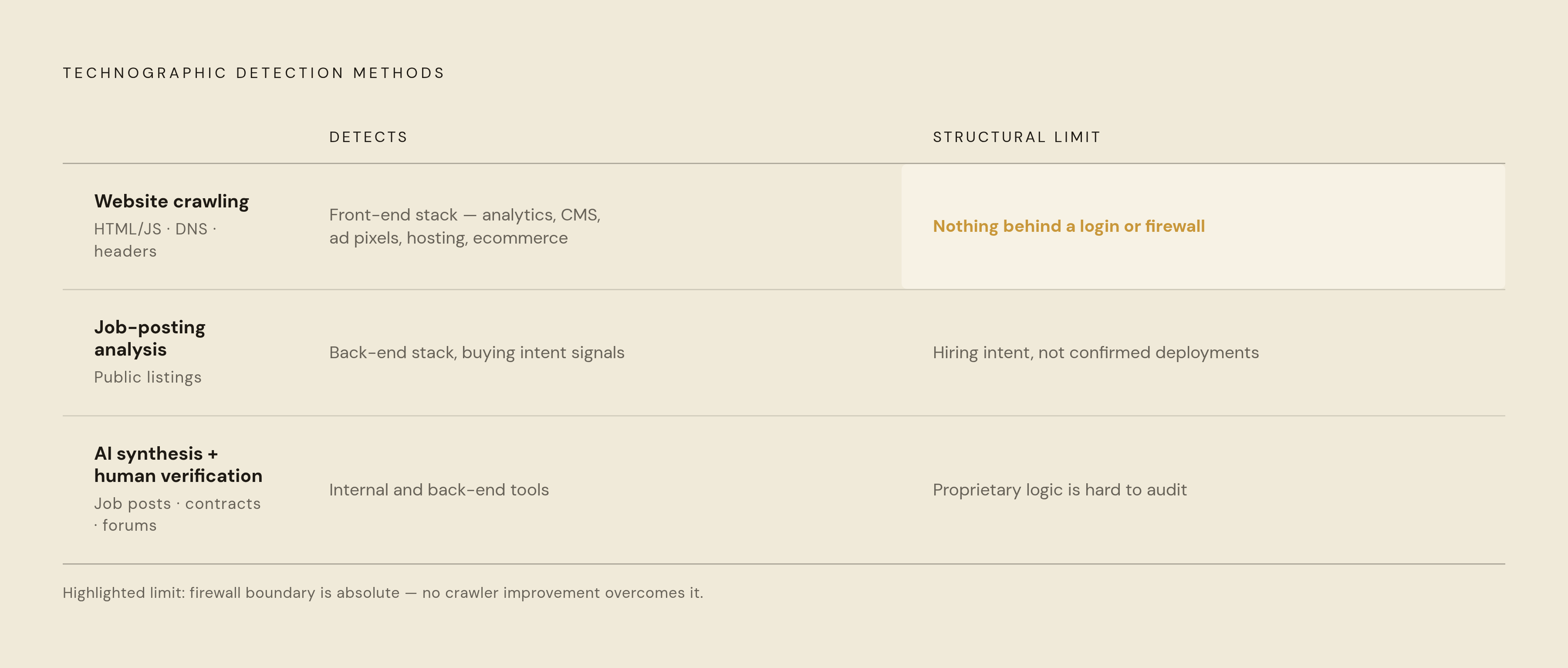
Accuracy differences between vendors trace back to how each one finds its data in the first place, and three approaches dominate the market: website crawling, multi-source AI synthesis paired with human verification, and job-posting analysis. Each has a hard boundary built into how it works, and no single method sees the full technology stack a company runs.
Crawling scans what's public: HTML, JavaScript tags, DNS records, HTTP headers. It's accurate at identifying front-end technologies such as analytics tools, content management systems, ecommerce platforms, advertising pixels, and hosting providers, because those leave visible fingerprints on a public website. It cannot see anything that runs behind a login screen or a corporate firewall, because there is nothing on a public-facing page for a crawler to read.
Multi-source AI synthesis works differently. It pulls signals from job postings, contracts, community forums, and other scattered sources to infer what a company runs internally, including tools that never touch a public website. Human verification is what separates this from a guess: a researcher checks that a detected signal actually corresponds to the right product at the right company, rather than accepting any pattern match as a confirmed deployment. That verification step carries a tradeoff. Proprietary AI detection logic can be hard to interrogate when a specific data point looks wrong, and a buyer who needs to explain a data-driven decision to a sales leader or a board needs to know whether a vendor can show its reasoning, not just its output.
Job-posting analysis works as its own signal type, not the same as scraping job boards for AI synthesis. It picks up the technologies a company is actively hiring for, implementing, or expanding, which reveals both back-end stack details and buying intent that a static website scan cannot produce.
One case makes the stakes concrete. A B2B infrastructure company found that public-facing signal detection gave it almost no visibility into the enterprise infrastructure products its prospects ran behind their own firewalls. So the team needed behind-the-firewall detection, built on anonymized resume and job posting data, because it had to see products that public signal detection methods simply cannot register. This was not a one-off gap for one unlucky seller. Any company selling into the enterprise infrastructure layer runs into the same wall, because the products that matter most to that pitch are, by definition, not sitting on a public homepage.
The implication for testing follows directly: a test designed around one provider's detection method will produce misleading results when pointed at a provider using a different method. Testing crawling-based data for behind-the-firewall coverage will always show a gap, but that gap says nothing about the quality of the provider's crawling. Methodology has to shape how you design the test before you compare a single number.
Data Decay and Point-in-Time Claims
Methodology sets the ceiling on what a provider can detect. But if a detection was once true, decay decides whether it still is. Technology stacks change meaningfully from year to year. A company running one CRM platform this year may have switched to a competitor's product by next year, and a technographic record that still shows the old platform isn't just outdated, it actively misleads a sales rep building a pitch around it.
Decay does not move at one speed across a database. Behavioral and intent signals expire fastest, often within weeks, but install-level data about what software a company actually runs decays more slowly, though it still decays meaningfully over time. A vendor that applies one refresh cadence across its entire database gets this wrong in both directions: fast-moving behavioral signals go stale before the next refresh even touches them, while slower-changing install data gets re-verified more often than it needs to be, burning resources that could go toward the faster-decaying fields instead.
The operational cost appears the moment a rep opens an account. If a company switched marketing automation platforms six months ago and the vendor record still shows the old one, the entire outreach pitch is wrong before the first sentence is written. That's why the right question to ask a vendor isn't simply how often it refreshes its data, but what the refresh cadence is by data type, and specifically how fast-decaying behavioral signals get handled compared to slower install-level records. A single blended refresh number hides exactly the distinction that matters.
This also means a single accuracy test has a shelf life. Testing accuracy is a practice to repeat as the buyer's own target accounts evolve, not a box to check once before signing a contract.
Designing the test sample: why your ICP is the only valid benchmark
A vendor's published accuracy rate, no matter how it was calculated, tells a buyer nothing about accuracy on that buyer's own accounts. The only test that produces a usable answer is one run against accounts where the ground truth is already known, independent of the vendor being tested.
You start building that sample from the buyer's own customer base, not from prospect lists. The right test set pulls accounts from the buyer's ICP where the technology stack is already confirmed, whether through direct customer relationships, existing CRM fields, partner integrations, or manual research already done for other reasons. A slice of 50 to 100 accounts with confirmed stacks produces more useful signal than a bulk export of thousands of accounts where nobody actually knows what's true. A bulk sample with unknown ground truth can't be scored at all, no matter how large it is.
Segmentation inside that sample matters just as much as the sample itself. Split accounts by company size tier, SMB, mid-market, and enterprise, because detection accuracy shifts across these tiers for structural reasons tied to how much of each company's stack is publicly visible versus buried behind internal systems. Split by geography too, particularly if European accounts are part of the buyer's territory, since crawling coverage and compliance posture both differ there in ways that affect what a provider can legally and technically detect. And split by technology category, separating front-end-visible tools from behind-the-firewall systems, because a provider's accuracy on one category says little about its accuracy on the other.
The most common objection to this approach is that a company doesn't have enough accounts where it knows the full stack to build a meaningful sample. Start with existing customers rather than waiting to find the perfect prospect list. A company's own customer base is the highest-confidence ground truth it has access to, and testing a vendor's output against known customers is a legitimate, efficient stand-in for testing against the full ICP. If the data is wrong on companies already under contract, there's no reason to expect it will be more accurate on prospects the buyer has never worked with.
What to measure: the four dimensions that distinguish providers
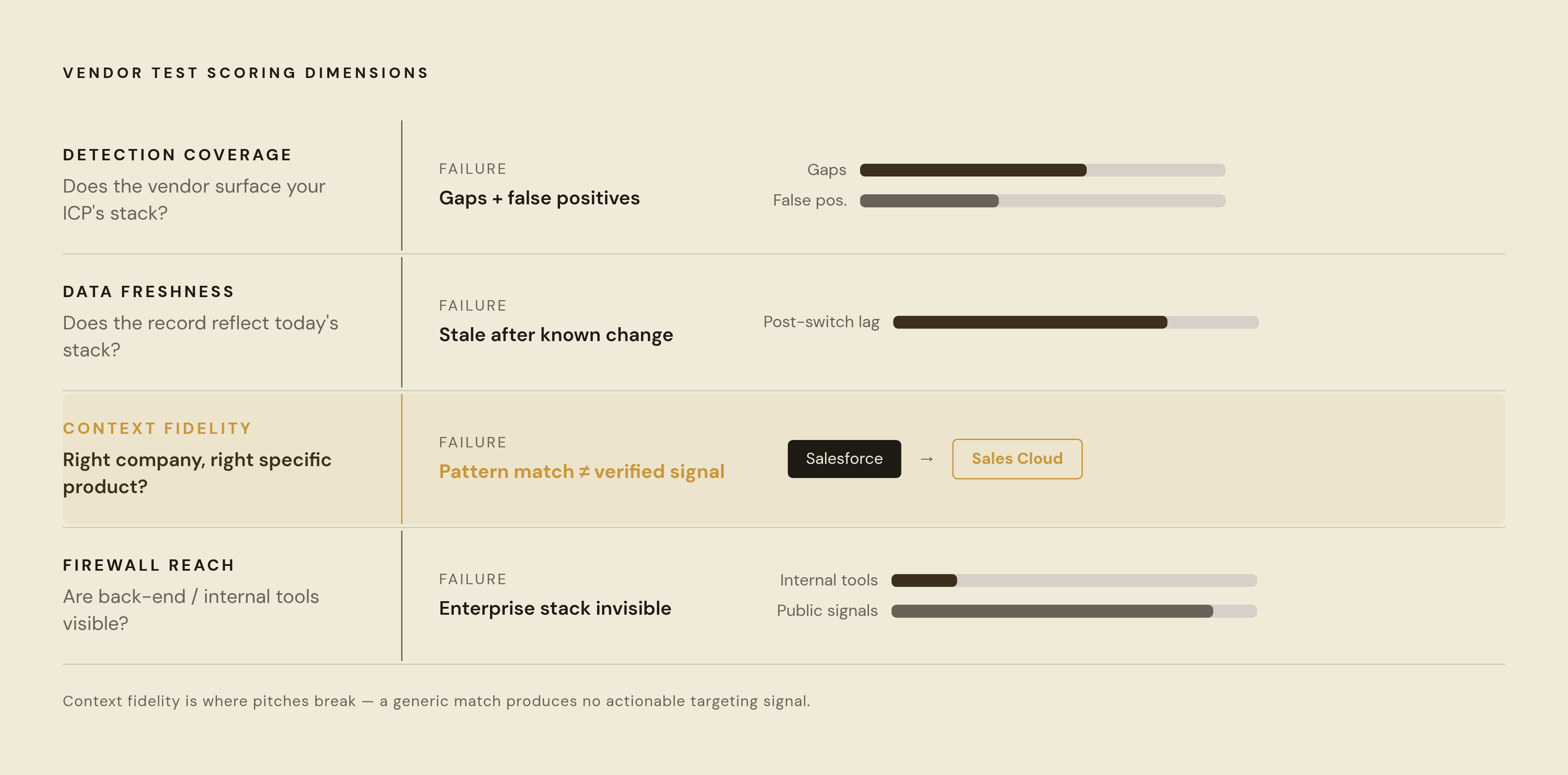
A test that produces one accuracy percentage hides more than it reveals. A meaningful test scores four separate dimensions, because a provider can perform well on one and poorly on another, and the right tradeoff depends entirely on what the buyer's ICP requires.
Detection coverage asks whether a provider surfaces the specific technologies that show up in the buyer's ICP, not how many total technologies the provider claims to track across its whole database. A vendor advertising tens of thousands of tracked technologies is not useful if it misses the three or four platforms a buyer's targeting actually depends on. Testing this means comparing vendor output against the known stacks in the sample and counting two kinds of errors separately: gaps, where a technology is present in the ground truth but absent from the vendor's record, and false positives, where the vendor reports a technology that isn't actually there.
Data freshness asks whether a record reflects the company's current stack, or just an outdated snapshot from an earlier refresh cycle. The sharpest test here uses accounts where a known change happened, a CRM switch, a platform deprecation, and checks whether the vendor's data caught up to it.
Context fidelity asks whether the provider correctly ties a detected technology to the right company and the right specific product, not just to a generic signal. There's a real difference between a record that says a signal for Salesforce was observed and one that says this specific company runs Salesforce Sales Cloud. The first is a pattern match. The second is a verified data point a rep can act on with confidence.
Behind-the-firewall reach asks how well a provider detects back-end and internal tools for enterprise accounts specifically. A provider relying purely on crawling will show gaps here by design, since those tools never appear on a public-facing page. You need to test not whether the gap exists, but whether it's large enough to break the buyer's specific use case.
How the leading providers compare on these dimensions
No provider scores highest across all four dimensions at once; a detection system built around one methodology rather than another produces exactly that kind of tradeoff. Understanding where each provider's method places its ceiling turns the choice from a popularity contest into a fit question tied to the buyer's own ICP.
SalesIntel's strength sits in context fidelity, built on a model that pairs machine detection with human researcher re-verification. That combination gives it a stronger claim to verified accuracy than a system relying on pattern-matched coverage alone, because a human is checking that a detected signal maps to the right product at the right company before it's recorded as fact. SalesIntel's own product description points to a database built on AI automation alongside AI-plus-human-verified B2B data, and it brings ICP modeling, buying intent signals, and buying committee mapping together into one system. For a buyer whose ICP depends on specific technology pairings, where a wrong data point leads to a wasted outreach cycle or a blown pitch, that verification layer is the dimension to weight most heavily when testing.
HG Insights builds its strength around behind-the-firewall reach for enterprise accounts, using multi-source AI analysis across job postings, contracts, buyer comments, and related sources rather than relying on what's visible on a public website. The company says it gets high accuracy from this AI-based methodology combined with human contextual verification. In 2025 it acquired TrustRadius, which added buyer review signals into the detection mix and pushed the product toward broader revenue intelligence beyond technographics alone. The same transparency tradeoff that applies to proprietary AI synthesis generally applies here: when a specific data point looks wrong, the underlying detection logic can be harder to unpack, which matters for a buyer who needs to justify a data-driven call to someone else inside the organization.
BuiltWith is built around web technology detection through crawling, and it gets this right across a very large number of sites. Its known limitation isn't inaccuracy on what it detects, it's sparse coverage of internal and back-end systems that crawling structurally cannot reach, regardless of how well the crawler itself is built. For a buyer whose ICP is defined by front-end signals, ecommerce platforms, analytics tools, CMS choice, hosting provider, that scope lines up directly with what the buyer needs to see, and the behind-the-firewall gap may matter little.
Running the test: a step-by-step protocol that controls for methodology differences
If a protocol doesn't account for methodology differences, it will produce a result that flatters whichever provider's strengths happen to match the test's blind spots. Four steps keep the comparison honest.
Start by defining the test scope before contacting any vendor. Lock in the sample accounts, the specific technologies being tested, and the scoring dimensions before a single vendor export arrives. Waiting to define scope until after seeing the first vendor's data invites unconscious anchoring to whatever that vendor happens to do well. The single most important control inside this step is to separate the sample into front-end-visible technologies and behind-the-firewall technologies from the start, because mixing them produces one composite score that hides each provider's actual ceiling.
Next, ask each vendor for a time-stamped export, so every record carries a date. This single request does a lot of work: it lets the tester tell apart a freshness failure, where detection was accurate but the record has gone stale, from a detection failure, where the vendor never found the signal. Those two failure types need different fixes, and a test that can't distinguish them can't tell a buyer what to do next.
Score each of the four dimensions, detection coverage, freshness, context fidelity, and behind-the-firewall reach, as separate columns. A single blended score can bury a real tradeoff. A provider might score low on freshness but high on context fidelity, and whether that tradeoff works depends entirely on the buyer's use case, not on which number is bigger.
Finally, test the refresh claim directly. Pull accounts where a technology changed in the past six months and check whether each vendor's record caught up to it. If a vendor states a specific refresh cadence, check it against the dated export and the known ground truth. A refresh claim that hasn't been checked against real accounts is just another version of the published accuracy rate this whole process exists to get past.