Stale CRM Contact Data and Outbound Performance Degradation
Stale contact data breaks outbound through five distinct failure modes, each requiring its own fix.
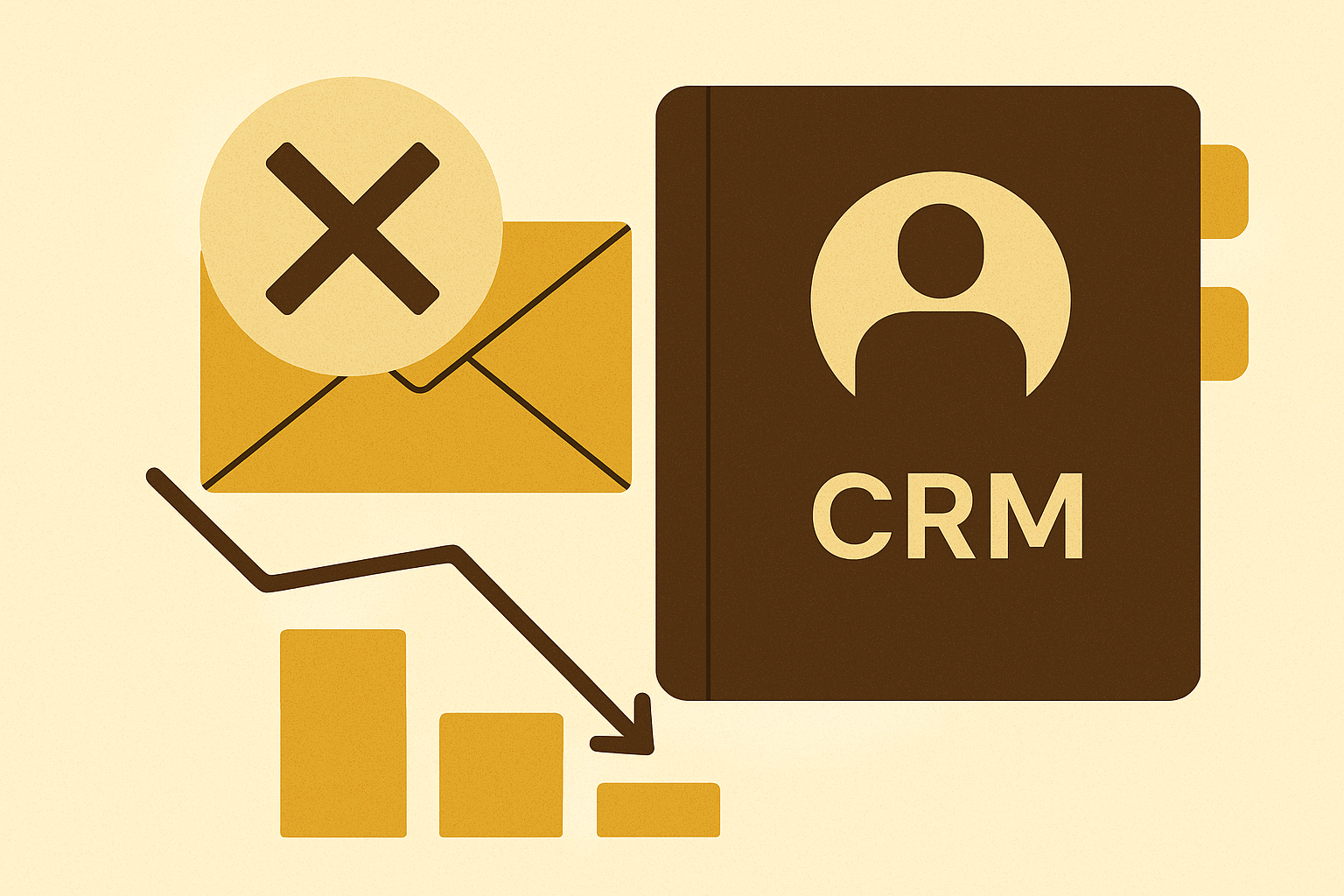
Stale CRM contact data does not degrade outbound performance evenly. It produces five distinct, traceable failure modes, bounced email, failed call connects, misrouted leads, corrupted AI signals, and phantom pipeline, and each one has its own cause.
Why outbound performance degrades in patterns, not randomly
When you diagnose a bad quarter, you tend to treat low reply rates, missed quota, and unreliable forecasts as unrelated problems, each needing its own fix. A messaging rewrite for reply rates, a coaching push for missed quota, a pipeline review for the forecast. But these symptoms share a root. Contact records underneath the sequences, the lists, and the scoring models are the common point of failure that most outbound diagnosis never reaches.
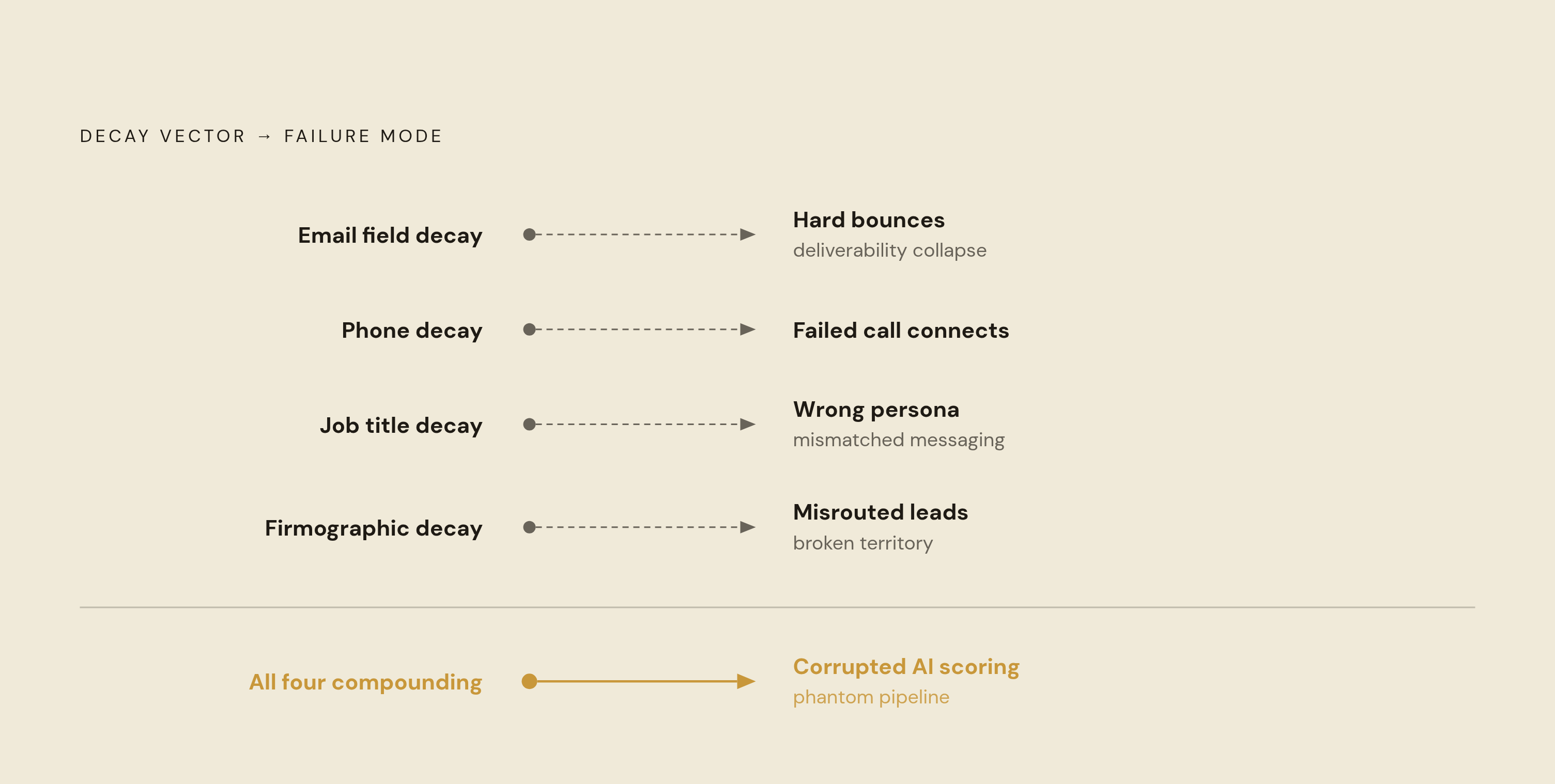
The five failure modes that recur across outbound programs, hard bounces, failed call connects, misrouted leads, corrupted AI signals, and phantom pipeline, are not variations on a single theme. Each one traces back to a specific kind of data decay, and the fix for one does nothing for another. Apollo's 2026 analysis states the stakes directly: inaccurate B2B contact data breaks every stage of the outbound funnel at once, targeting, delivery, personalization, and sales acceptance all suffer together. Treating that as one undifferentiated "data quality" problem, and applying generic hygiene pressure everywhere, leaves most of the actual damage in place. What follows maps each symptom to the decay vector that causes it, so the diagnosis can move from what broke to why.
How B2B contact data decays
Data decay does not happen because a rep misspells an email or fills out a form wrong. It happens continuously, driven by something no sales team controls: people changing jobs. Every contact record in a CRM is a snapshot of a person at a moment in their career, and that snapshot starts going out of date the moment it's saved.
The mechanism compounds within a single event. When a contact changes roles, several things happen simultaneously. The business email changes. The direct line changes. Budget authority shifts, sometimes up, sometimes down. Receptivity to any given message changes too, because a new role comes with new priorities. One person's move produces four or five field failures in the same record, all at once, with no warning to the systems depending on that record.
MarketingSherpa research, cited by HubSpot, puts the compounding effect at roughly a fifth of a B2B database going inaccurate every year, without a single person doing anything wrong. That is the baseline rate when nothing unusual is happening in the labor market. The current environment pushes past that baseline. Median employee tenure is now at its lowest point on record in decades, and one labor-market tracker recorded millions of quits in a single recent month alone. The churn producing contact decay is structural, built into how long people now stay in any one job.
Not every field decays at the same speed. ZoomInfo's RevOps guide identifies the fields go-to-market teams depend on most as the same fields that decay fastest: job title, direct-dial phone number, business email, and company firmographics. A job title drives messaging relevance directly. A contact logged as "VP of Sales" who has since moved to "Director" means every personalization token built around that title fires against the wrong person. Business email is tied to employment, so when someone leaves a company, it breaks. Direct-dial numbers move with the role. Firmographic fields, headcount, revenue, industry, shift when companies restructure, merge, or get acquired. Technology-sector contacts decay faster than the aggregate benchmark, driven by quicker role turnover, more frequent restructuring, and funding-driven headcount swings. SaaS and tech outbound teams are working against a faster clock than the headline rate suggests.
How email field decay produces deliverability collapse
Email is where stale data turns into damage fastest, because the consequence isn't confined to the stale records. It spreads to every future send, even to contacts whose information is still accurate.
The mechanism runs in two stages. First, if you send sequences against stale addresses, you get hard bounces, and the bounce volume rises with how many records in the list carry an undetected address change. When bounce rates run high, mailbox providers read that as a sign trust has failed. Once sender reputation drops as a result, deliverability penalties apply to all outgoing mail from that domain, not just the messages that bounced. Apollo's 2026 analysis describes the resulting cascade: once domain reputation drops, every email sent afterward, even to valid, interested prospects, faces a deliverability penalty. That turns deliverability into a go-to-market metric that sales and RevOps leaders need to watch directly, not something left to marketing operations alone.
The platform environment has made the consequences of that cascade sharper than they used to be. From November 2025 onward, Google scaled up enforcement of its spam complaint rate framework, and now issues permanent rejections under error 550. Microsoft started its own bulk sender enforcement in May 2025, and now, if mail doesn't meet its published requirements, it gets rejected. A sending domain that burns through its reputation on a stale list is no longer looking at a temporary dip in open rates. It is looking at an infrastructure problem that can take months of recovery to undo, during which every subsequent campaign, built on good data or bad, sends into a damaged reputation. That is what makes email decay different from the other failure modes: it doesn't stay contained to the records that caused it.
Phone and title decay don't threaten infrastructure the way email decay does, but they produce failures just as traceable, and just as often misread as something else.
How phone and title decay translate into failed connects and mismatched conversations
Phone and title decay rarely get attributed to data quality, because the failures they cause look just like rep performance problems or messaging problems. That's precisely why they tend to go unfixed the longest: the symptom points everywhere except the actual cause.
Direct-dial numbers change with role changes, and when a contact leaves a company, the number gets reassigned or disconnected. A rep dialing a stale direct-dial reaches someone else, or reaches no one. The connect never happens, the call gets logged as a failed attempt, and quota pressure lands on the rep's activity numbers. ZoomInfo's RevOps guide names this directly: it maps missing direct-dial numbers to failed call connects and lower pipeline conversion as its own distinct failure mode. Mobile numbers hold up better, since they follow the person rather than the role, but most CRMs don't structure their fields to separate a work direct-dial from a personal mobile, so the phone field as a whole carries mixed reliability no matter how it's used.
Title decay changes the content of the conversation while leaving the ability to have one intact. A record still showing "VP of Sales" for someone now working as a Director, or "Director of IT" for someone promoted to CTO, sends an entire outbound sequence at the wrong persona. Messaging built for a VP-level buyer lands in a Director's inbox instead, and the reply rate drops in a way that looks like a copywriting problem. Apollo's 2026 analysis calls this out directly: a wrong job title or seniority field produces mismatched messaging and a lower reply rate, a data failure dressed up as a content failure. Budget authority moves with title changes too, so a sequence built for a decision-maker can land two levels below actual buying authority, and if that qualification mismatch goes unnoticed, it can burn through an entire sales cycle. Apollo's mid-market productivity analysis extends this past prospecting into live deal management: for account executives managing active deals, an incorrect stakeholder record means walking into a conversation prepared for the wrong person's role.
How firmographic decay misroutes leads and corrupts territory coverage
Firmographic decay operates at the account level, and it produces a failure that belongs to RevOps infrastructure, not to any single rep's execution.
When company-level fields decay, headcount, revenue range, industry classification, headquarters location, a CRM's routing logic keeps firing against a record that no longer describes the account it's attached to. Most lead routing rules run on firmographics: a lead from a 500-person company routes to the enterprise team, a lead from a 50-person company routes to SMB, a lead from a healthcare account routes to the healthcare vertical rep. When the firmographic field is wrong, the routing is wrong, and response time and conversion both suffer before a rep ever gets the chance to engage the lead. Apollo's mid-market analysis names this failure directly: incorrect firmographic fields send inbound leads to the wrong rep or the wrong territory, and the resulting friction delays follow-up and lowers conversion. ZoomInfo's RevOps guide maps stale firmographics to broken segmentation and targeting, and separately flags that incorrect territory or account assignment slows response time across the board.
Company acquisitions and internal restructuring move faster than almost any other decay vector at the account level. When a target account gets acquired, its headcount, parent company, revenue classification, and territory ownership can all change at once, and the CRM record has no mechanism to catch up unless an active enrichment process is running against it. Left alone, the record keeps routing leads as if the acquisition never happened.
The downstream effect reaches all the way into pipeline reporting. Apollo's mid-market analysis found that duplicate opportunities and inactive accounts inflate coverage ratios, so pipeline looks healthier on a dashboard than it is in the field. Pipeline reviews built on that kind of data stop being conversations about deal strategy and turn into arguments about whether the numbers on the screen can be trusted. That same distortion, bad firmographic and contact data feeding a system that can't tell good records from stale ones, becomes far more consequential once AI tools enter the outbound stack.
How stale CRM data corrupts AI-powered outbound and scoring workflows
AI tools built for outbound have no way of knowing a contact record has gone stale. They score, sequence, and fire against whatever data they get, scaling every upstream error.
Garbage in, garbage out is older than AI outbound, but it does more damage inside an AI workflow than it ever did in a manual one, because AI systems operate at a volume and speed no manual process can match. If a model scores against outdated titles, missing company sizes, or duplicate account records, it produces wrong prioritization across an entire list at once, where before one rep made one bad call at a time. ZoomInfo's RevOps guide names this as its own failure mode outright: garbage-in-garbage-out for AI scoring, sequencing, and routing models, with corrupted AI workflows listed as a direct consequence of poor contact data.
Volume makes the problem move faster. AI systems now generate a growing share of outbound messages, and nothing in that process pauses to check whether a given contact's record is 18 months out of date. The system burns through send limits on invalid addresses, triggers spam traps, and erodes sender reputation, compounding the same deliverability failure described earlier, now running at AI-driven scale.
What follows is a trust collapse inside the sales organization itself. When AI-driven scoring keeps surfacing contacts that bounce or never connect, reps stop trusting the model's output and go back to building lists by hand, erasing the productivity case that justified adopting AI outbound. A data quality problem turns into a technology adoption problem. Vendors in the automated outbound category have already faced documented churn after their systems fired at stale or low-quality contact lists and produced no booked meetings over extended engagements, and in those cases the data feeding the system, not the AI itself, was the root cause. Understanding that chain, from decayed record to corrupted score to lost trust in the tool, is what makes it possible to interrupt the failure before it compounds any further.
Why rep productivity is the hidden cost that connects all five failure modes
Every failure mode described so far costs a rep time somewhere on their calendar. Hard bounces mean time spent drafting sequences that never reach an inbox. Failed call connects mean dialing minutes spent on disconnected lines and wrong numbers, logged as activity that produced nothing. Misrouted leads mean a rep working a deal that was never theirs to close, or missing one that was. Corrupted AI signals mean time spent either trusting a prioritization list that was wrong from the start, or abandoning the tool and rebuilding the list by hand. Phantom pipeline means hours spent in review meetings arguing about which opportunities are even real.
No sales dashboard labels this as "data decay" in a line item. It appears instead as missed quota, as a forecast that keeps sliding, as a rep who logged forty dials and connected with four people. Sales leaders read those numbers as an execution problem, because that's what they look like from the outside, and they respond accordingly, with coaching, with new scripts, with pressure to work harder against the same stale list. Every one of the five failure modes traces back to a specific, identifiable field decaying in a specific, identifiable way. Title decay drives reply rates down. Phone decay drives connect rates down. Firmographic decay drives misrouting. Email decay drives reputation damage. Pipeline integrity fails when all four kinds of decay compound at once inside systems, including AI systems, that have no way to tell a current record from a stale one. Fixing rep productivity starts with recognizing that the hours lost to each of these failures were never a rep performance problem to begin with.