AI SDR Platforms vs Traditional Sequencing Tools for SMB Sales Teams
AI SDRs and sequencers solve different problems, not a binary choice.
Sales leaders at small and mid-sized companies keep asking the wrong question when they shop for outbound tools. Most treat the choice as a straight swap: rip out the sequencing platform and replace it with an AI SDR, or the reverse. That framing assumes one system is simply a better version of the other, and it's costing teams real money. Annual churn on AI SDR tools runs at roughly double the turnover rate of the human reps those tools are supposed to replace, UserGems 2026 data shows, a gap that points to buyers expecting results the tools were never built to deliver. The two systems aren't competing on sophistication. They solve different problems, and the useful question isn't which one is smarter, it's which failure mode in your outbound motion you're actually trying to fix. This guide works through that distinction structurally, using fit rather than feature counts as the test.
What rules-based sequencing does
They sit between the CRM and the seller, coordinating multi-step sequences across email, phone, and SMS, and logging every outcome back into the CRM so managers can see what happened and when. The logic is if-then: if a prospect opens an email but doesn't reply, the system waits three days and sends the next step; if the reply contains a negative keyword, the sequence pauses or the contact gets pulled out entirely. Personalization goes as far as a merge tag, a name or company or job title dropped into a template a human wrote in advance.
That architecture breaks down the moment a reply requires judgment rather than pattern-matching. When a prospect writes back "we tried something similar last year and it did not work," a rules-based system has exactly two options: pause the sequence or fire the next scheduled step. It can't ask what went wrong, acknowledge the objection, or shift the pitch to address it, because nothing in the system is built to interpret what the sentence means.
That limitation isn't a flaw so much as the tradeoff for what SEPs are actually good at. Amplemarket's 231-point capability audit scored Salesloft at 92 out of 231, with both Outreach and Salesloft landing near the bottom on deliverability and returning close to zero on AI and automation capabilities. Outreach's AI features are assistive, suggestions and lead scoring that a rep still has to act on, not an engine that runs prospecting end to end. Where both platforms genuinely lead is sequencing depth, deal workflow management, conversation intelligence, and the CRM logging that gives a sales manager full visibility into what every rep is doing. Vendr contract data shows both carry substantial annual costs, enterprise-level price floors for tools that still require a human making every decision. It's specialization in exactly the problem SEPs are meant to solve: keeping execution consistent across an entire rep team, so that process doesn't depend on which individual happens to be running a given account.
What intent-based AI execution does
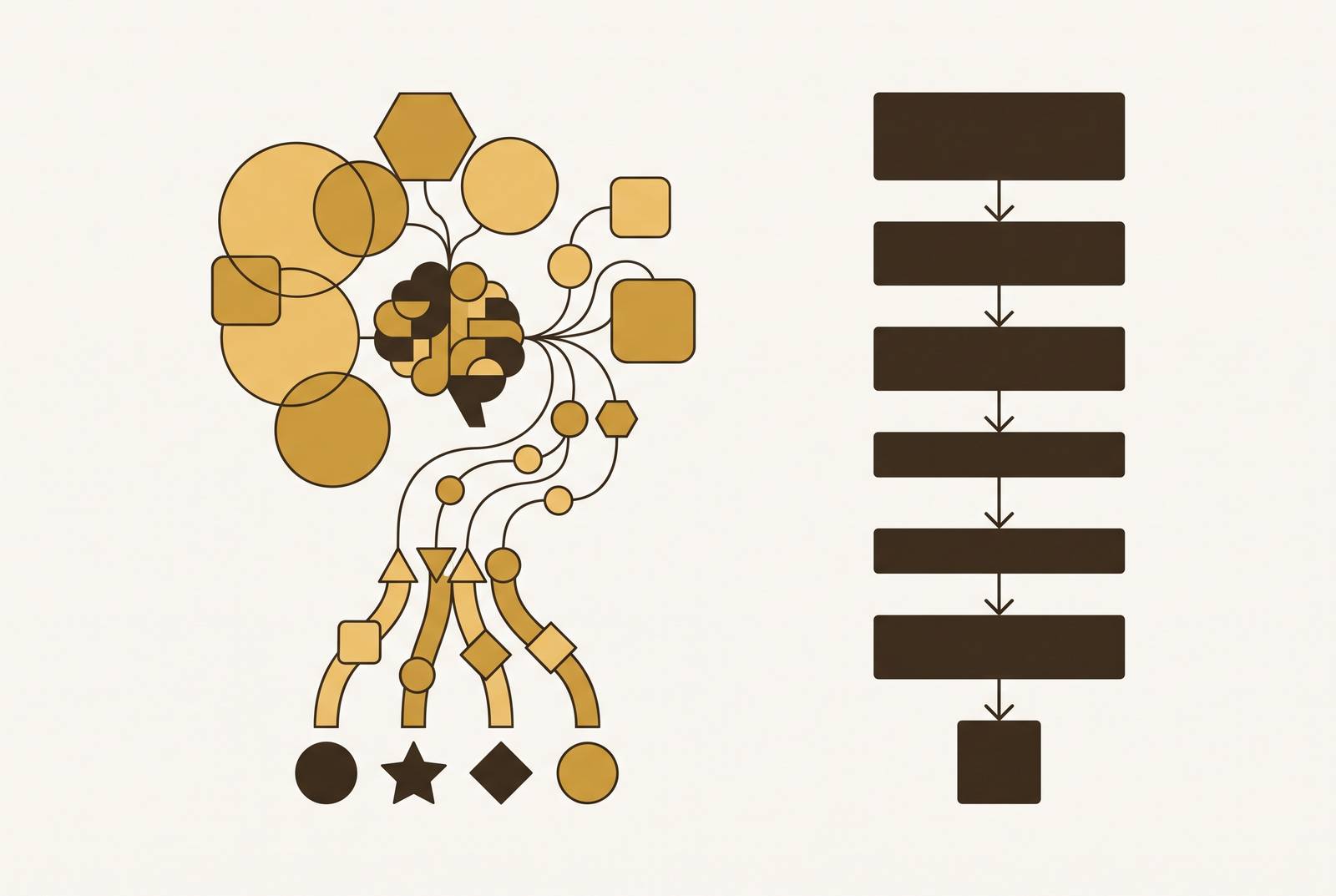
AI SDR platforms are built for a different category of problem. Rather than enforcing a pre-written sequence, they take in unstructured input, work out what a prospect actually means, and decide what to do next on their own. An SEP automates a faster version of the same task execution, while intent-based AI performs a different kind of labor altogether.
An SEP operates on sequences: send this email, wait three days, send the follow-up. An AI SDR operates on tasks: read this reply, decide the next move, enrich this lead record, judge whether this conversation is worth pursuing. Fed the reply "not interested right now, check back in Q3," an AI SDR decides on its own whether to set a Q3 reminder, send a short acknowledgment, or drop the contact, with no human triaging the response first. MutinyHQ reports these systems can process more than 1,000 contacts a day, respond in seconds instead of hours, and keep working outside business hours, which matters for lean SMB teams with no night or weekend coverage.
Some of the strongest AI platforms don't wait for a rep to add a name to a list at all. They start outreach the moment a buying signal fires, a job change, a funding round, a competitor evaluation. That speed compounds into a real structural edge: human SDR teams average a 47-hour lead response time, while AI SDRs respond in under a minute, around the clock. For a small team with no after-hours coverage, that gap by itself can be reason enough to adopt the technology.
The category isn't one thing, either. Fully autonomous AI SDR platforms, the ones that prospect, write, send, and qualify without a human in the loop, are architecturally different from AI copilot tools that generate content or score leads for a rep to act on. That distinction matters a great deal for an SMB deciding what to buy, because the two categories carry very different costs and very different conversion profiles, which is the tension the next section takes on directly.
The conversion trade-off that changes the SMB math
AI SDRs send more outreach, but convert less of it, and that trade-off lands harder on a small company than on a large one, because a small company can't out-volume the gap. SuperAGI's comparative analysis puts human SDRs at roughly a 25% meeting-to-qualified-opportunity conversion rate, well above what AI SDRs achieve, with the shortfall concentrated in relationship building, objection handling, and the contextual judgment a human applies in the moment a prospect pushes back.
That gap isn't a bug waiting on a patch. That gap is the direct consequence of the same design choice that makes volume possible in the first place: a system built to optimize for throughput isn't also optimized for the judgment call that shows up when a prospect resists. An enterprise team working a large total addressable market can run the volume math and still land plenty of net new meetings even at a lower conversion rate. A small company working a narrow market can burn through its best prospects before the system has enough signal to calibrate.
The data points toward a middle path rather than an either-or. Companies that use AI to augment human SDRs, instead of replacing them outright, generate meaningfully more pipeline than companies that go all-in on automation. Bridge Group's 2026 SDR Metrics report found that hybrid pods, a human SDR paired with AI support, produce substantially more meetings per dollar spent than AI-only setups. Reps using AI to do more human work are outperforming reps using AI to remove the human work entirely.
Belkins' 2025 study adds a related data point: campaigns sent to smaller, more targeted recipient lists get a meaningfully higher response rate than campaigns sent to large, broad lists. The direction of the category is toward narrower, signal-triggered micro-campaigns, not bigger sends. None of this argues against AI SDRs as a category. It argues for matching the configuration, hybrid versus full automation, to the size of the market a given company is actually working.
Deliverability: how a volume advantage becomes a domain liability for SMBs
High-volume AI sending creates a deliverability risk that a large company can absorb and a small company usually can't, because a damaged sending domain doesn't just hurt the outbound campaign, it affects every email the company sends afterward. Analysis of a large email dataset found that AI-SDR-style sending pushed far more volume than manually run campaigns, but at substantially lower reply rates, so more email goes out while the domain takes on damage faster.
AI-generated cold email gets flagged as spam at a meaningfully higher rate than human-written email, and inbox providers are getting better at detecting AI-generated content faster than senders are adapting their approach. Google, Yahoo, and Microsoft now require senders above a daily volume threshold to maintain proper authentication (SPF, DKIM, DMARC), keep spam complaint rates low, and offer one-click unsubscribe; senders who don't meet those requirements see large portions of their email routed straight to spam or rejected outright.
For a small company, that's not a marketing problem, it's closer to an existential one. The primary domain handles customer support threads, vendor invoices, and sales follow-up alongside cold outreach, so burning that domain's reputation on a prospecting campaign carries consequences well beyond the campaign itself. Most deliverability specialists now recommend running cold outbound from a separate sending domain entirely, specifically to protect the reputation of the domain the company actually depends on. That recommendation adds infrastructure and cost that many SMBs never factor into their AI SDR budget in the first place. Instantly's infrastructure guidance treats distributed sending infrastructure, pre-warmed domains, and strict sending pace as a baseline requirement, not an optional add-on, and that requirement holds under either an AI SDR setup or a traditional SEP.
Compliance adds another layer on top of the infrastructure cost. GDPR imposes fines of up to a significant share of global annual turnover per infringement for data tied to EU residents, and CCPA imposes substantial per-violation penalties for intentional violations involving California residents. Any AI SDR processing contact data at scale needs a signed data processing agreement, a documented lawful basis for that processing, and transparency from the vendor about which sub-processors touch the data. None of this is exotic. It's the baseline cost of sending at volume, and it's the cost structure that determines which companies can realistically run a fully autonomous AI SDR and which ones should be looking somewhere else.
The SMB adoption gap
Small companies have not been slow to adopt AI SDR platforms because they're behind the curve technologically, even though enterprise B2B teams are running AI SDRs in production at a rate several times higher than SMBs, a reversal of the usual SaaS adoption curve where SMBs lead on lightweight tools. They've been slow because the price floors, the infrastructure demands, and the conversion trade-off described above structurally favor companies with more volume to spare. SMB adoption of AI SDR tools did grow, from a small fraction of teams in Q1 2025 to roughly one in seven by Q1 2026, but that base still sits well below mid-market and enterprise adoption rates.
The tools SMBs have actually adopted tell the same story from the other direction. Lemlist, scored as the best option for creative SMB outreach, and Instantly are both available at a fraction of the cost of a full AI SDR platform, and both are sequencing and sending tools rather than autonomous agents. Line up the three adoption tiers, enterprise, mid-market, and SMB, against the price bands of the tools in each category, they track almost exactly, which is a fit problem wearing the costume of an awareness problem. SMBs aren't failing to notice AI SDRs exist; they're making a rational call about what their budget and their risk tolerance can support.
That gap is narrowing from an unexpected direction. Salesforce, HubSpot, Outreach, and other CRM platforms are building autonomous agent capability directly into the workflows companies already use. A company already running HubSpot gets a lower-friction on-ramp to autonomous agent functionality through that native integration than it would get standing up a separate AI SDR platform from scratch. And even without full automation, there's one case where the economics favor SMBs outright regardless of conversion rate: speed-to-lead. Human teams take hours or days to respond to a new lead; AI SDRs respond within minutes, around the clock, which matters most to exactly the kind of lean team that has no after-hours coverage to begin with.
Identifying which type of outbound breakdown you have
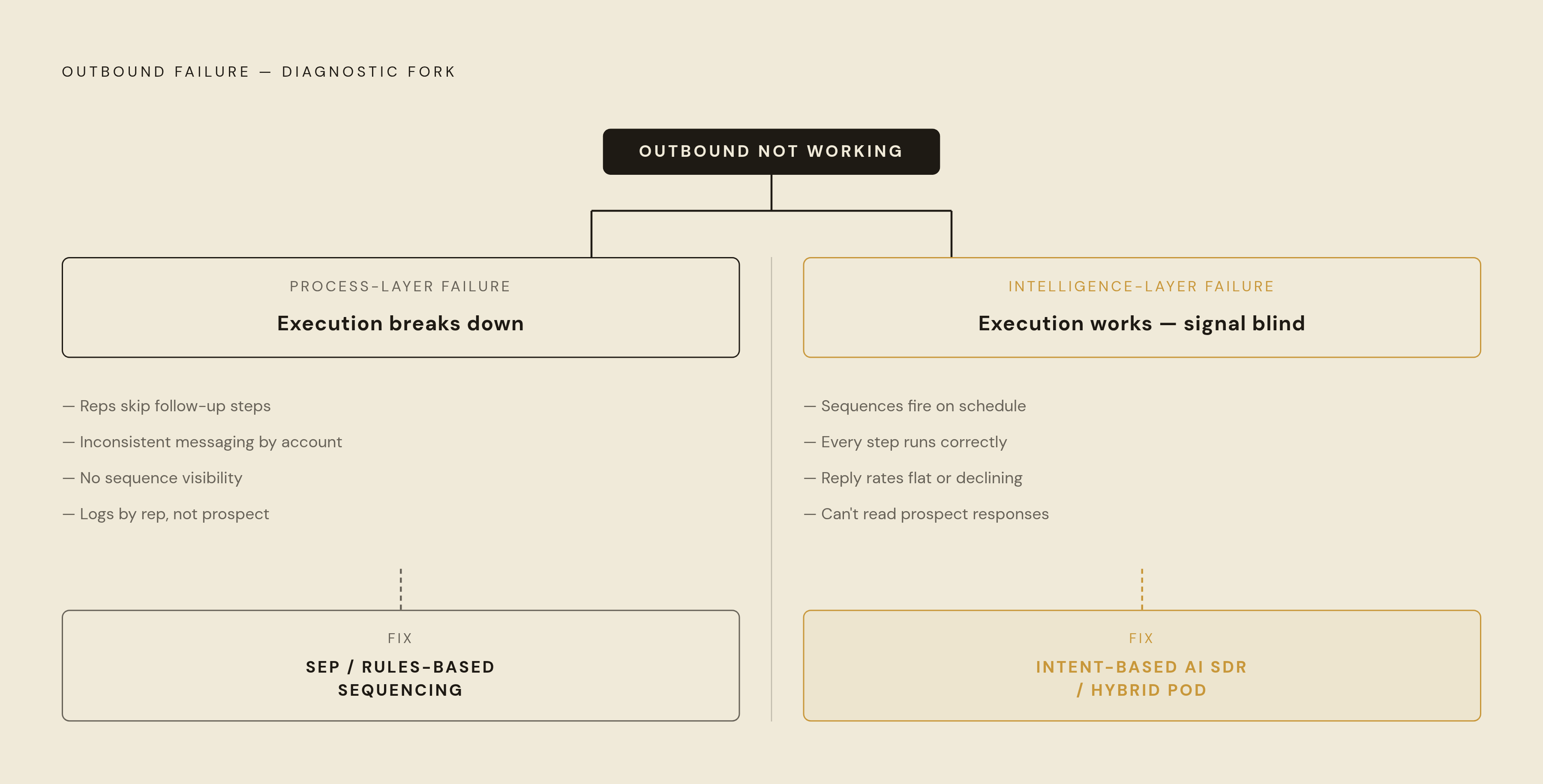
Everything above points to one practical test: figure out whether outbound is failing at the process layer or the intelligence layer before shopping for a tool to fix it. Those are different failures, and they call for different architecture.
Process-layer failure is visible in reps skipping follow-up steps, messaging that varies depending on who's running the account, no clear visibility into which sequences are live at any given time, and activity logs that track by rep rather than by how a prospect actually behaves. That's the exact problem SEPs were built to solve: consistent execution, enforced the same way across every member of the team, with full logging back to the CRM.
Intelligence-layer failure looks different. Sequences run exactly as designed, every step fires on schedule, and reply rates still sit flat or keep declining. Outreach lands with the right volume and the right cadence but misses on message, timing, or targeting, because nothing in the system is actually reading what prospects say back or adjusting course based on it. That's the gap intent-based AI execution is built to close, interpreting replies, picking the next action, and reacting to buying signals as they appear rather than waiting for a rep to notice them. AI SDR platforms are built to run outbound autonomously, interpreting signals and acting on them without waiting for a rep to assign the next step.
A small company diagnosing its own outbound motion should ask three things before buying anything: first, whether the problem is that touches aren't happening consistently, or that touches are happening but not landing; second, does the market being worked have enough volume to absorb a lower conversion rate while an AI system calibrates, or is the prospect list small enough that burning through it carries real cost? Third, is the domain and sending infrastructure actually ready for the volume a given tool will generate, with authentication, pacing, and a separate sending domain already in place? The honest answer to those three questions points toward an SEP, a hybrid pod combining AI support with a human SDR, or a CRM-native agent layered on top of a platform already in use, and it does more to determine the right purchase than any feature comparison between two vendors ever will.