Contact Enrichment Matching Logic and Fuzzy Matching Failure Modes
Matching errors silently corrupt enriched data across your revenue stack.
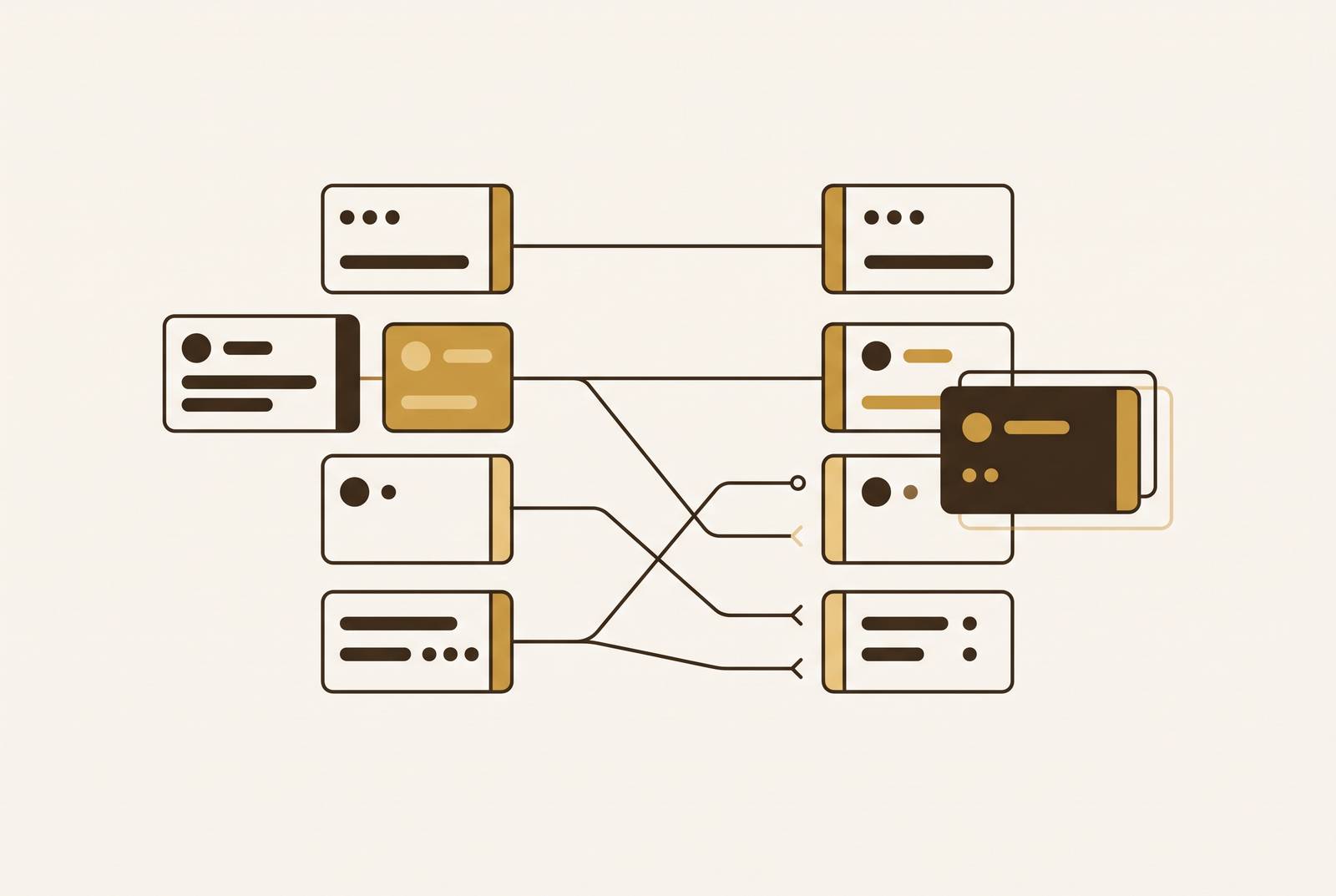
A sales rep dials a number that was disconnected two years ago. An SDR sends a personalized email to someone who left the company it names. Both failures trace back to the same place: not the enrichment vendor's database, not the volume of data on hand, but the matching layer that decided which external record belonged to which internal contact. Contact enrichment exists to append verified third-party attributes to CRM records so teams don't have to chase that information down manually, and the value of what gets appended depends entirely on whether the system correctly identified the right person or company first. CRM data decays on its own schedule, with titles, direct numbers, work emails, and company associations all shifting at different rates, so enrichment is a process that runs repeatedly against a target that keeps moving.
When matching fails, the result is rarely a blank field. That distinction matters because every downstream workflow, lead scoring, territory routing, campaign execution, AI-driven prioritization, draws from whatever the matching layer decided and treats it as fact. A single silent mismatch doesn't stay contained. It compounds across the revenue stack, because scoring models, routing rules, and outreach sequences all inherit the same record with no way to question it. When enrichment, scoring, and routing all pull from the same foundation, every connected system inherits the same gaps, or the same wrong data, without distinction. The rest of this piece maps where that matching layer breaks, and why each break produces a different kind of damage.
What matching logic does, from exact to fuzzy
Matching logic runs along a spectrum, and where a system operates on that spectrum is a deliberate design decision with costs attached at either end. Manual entry, API imports, web forms, and legacy migrations rarely produce identical representations of the same entity, so exact matching fails constantly in multi-source B2B environments. They're the ordinary condition of the data itself.
Fuzzy matching exists to bridge that variation. Instead of requiring identity, it computes similarity between strings and accepts a match once that similarity crosses a set threshold. Several techniques handle different kinds of variation: edit-distance algorithms like Levenshtein measure how many character changes separate two strings; phonetic algorithms like Soundex and Metaphone catch words that sound alike but are spelled differently; token-based methods compare pieces of a string rather than the whole; n-gram overlap measures shared character sequences. Each is tuned for one kind of variation and blind to others.
Enrichment itself starts with an identifier, an email address, a LinkedIn profile URL, or a name paired with a company domain, and the strength of that identifier determines what kind of matching is even possible. Loosening a match threshold catches more genuine matches but lets more wrong ones through; tightening it protects against wrong matches but leaves genuine ones unenriched. That tension cannot be solved outright, only managed, and the failure modes covered in the rest of this piece are what happen when it isn't managed well.
How anchor quality determines match reliability
The single biggest lever on match quality is the quality of the identifier handed to the algorithm, not the algorithm's sophistication. Consider a CRM record for a common first-and-last name at a large company, with no email and no LinkedIn URL attached, just a name and a company. The company likely employs more than one person with that name, and a matching engine asked to resolve that record has no way to tell them apart. It will return a plausible match, not necessarily the right one, because the input simply doesn't carry enough information to support a unique resolution.
This is anchor-quality collapse: the matching logic performs exactly as designed, but the input is too thin to resolve a single identity, so the system returns a plausible-but-wrong match as if it were a genuine resolution. Enrichment accuracy tracks closely with input quality, and any vendor reporting a high match rate without disclosing the distribution of input identifiers behind that number is reporting a figure that can't be compared to any other vendor's claim.
A related failure happens further upstream, before matching even begins. Before adjusting fuzzy thresholds at all, practitioners should audit what identifiers their CRM actually holds and what share of enrichment runs are forced to rely on weak anchors like name-only or name-plus-employer. No amount of algorithmic refinement recovers a match that the input never supported.
The two failure modes fuzzy thresholds produce
Every fuzzy threshold produces two kinds of error, and they move in opposite directions. If you loosen the threshold to catch more real matches, the system starts accepting false positives. But if you tighten it to avoid wrong matches, the system starts generating false negatives. Both corrupt CRM data, just through different mechanisms.
A false positive happens when minor textual variation, pluralization, inconsistent capitalization, a shared partial string, satisfies the similarity threshold and the engine accepts a match it should have rejected. The tool had performed exactly as configured. The configuration was the problem.
A false negative happens when a genuinely correct value gets rejected because it's formatted unusually, a stylized brand name, a nonstandard title, a legal entity suffix the engine doesn't recognize, and the matching logic treats a real variant as a mismatch. The CRM record either stays unenriched, or worse, a correct but unusual value gets overwritten with a normalized value that's actually wrong, because the engine "corrected" a string that didn't need correcting. This failure mode is quieter than a false positive, but it persists: records that should have been enriched stay stale, and any team relying on those fields for segmentation or scoring is working from gaps it has no way to see.
The asymmetry between the two matters for anyone setting thresholds in a B2B context. A false positive writes wrong data with full confidence attached. A false negative simply leaves a field empty, and an empty field is at least an honest signal that something is missing. A wrong value is a lie the system treats as fact, and nothing downstream is built to question it.
Firmographic matching failures: organizational ambiguity and the subsidiary problem
Everything covered so far concerns matching one person to one record. Company-level matching breaks for a different reason entirely: the problem isn't text variation, it's that the same company can legitimately present multiple distinct identities depending on which layer of its corporate structure is in view. No amount of fuzzy threshold tuning fixes this, because the ambiguity is in the organizational structure itself, not in the spelling.
A subsidiary frequently inherits its parent company's domain, so domain-based matching resolves a contact to the parent account instead of the operating entity that actually employs them. Holding companies add another layer on top: the entity visible in public records, the holding company, can obscure the operating entity that actually runs the buying process, so firmographic enrichment ends up pointing to a company that has no real decision-making authority over the deal.
Using company name as a matching anchor only makes this worse. Homonyms, legal suffixes like Inc., LLC, Ltd., and GmbH, and subsidiary names that partially overlap with their parent's name all satisfy fuzzy thresholds while pointing to entirely different legal entities. The more reliable approach resolves a company name to its domain first, then enriches from that domain, rather than trying to resolve every firmographic field directly from the name. Domain resolution collapses an ambiguity that name-based fuzzy matching has no way to untangle on its own, though reconciling name to domain is itself a distinct discipline, since legal suffixes and subsidiary naming conventions defeat naive string comparison just as easily at that stage.
Recent rebrands create a time-bound version of the same failure. A company's new name hasn't yet propagated into the enrichment vendor's underlying database, so the matching engine resolves it to the old identity or fails to find a match. That makes the recency of the underlying data source a variable that no matching algorithm, however well designed, can compensate for on its own.
Enrichment writes that conflict with existing CRM data
A record can be matched correctly and still corrupt the CRM, if the enrichment system writes the new value without first checking whether it outranks what's already stored. This is last-write-wins failure, and it does as much damage as a wrong match, because the matching was correct and the data still ends up wrong. Without confidence-ranked conflict resolution, an enrichment run can overwrite a known-good value with a lower-confidence one for no reason other than that it happened to run more recently. The fix is straightforward in principle: write only when the new evidence outranks the stored value, and preserve the existing value otherwise, logging the decision either way. Most enrichment configurations don't implement this by default. The failure is a governance problem: a missing policy for ranking confidence before writing.
Multi-vendor enrichment setups make the problem worse. A contact record passed through three enrichment tools in sequence can end its lifecycle holding the least accurate value from each tool on every field, with the outcome on each field determined entirely by the order the tools happened to run in.
Matching quality and write governance can't be separated in practice. A system that matches every record correctly still produces a corrupted CRM if it lacks a principled policy for deciding which value wins when two sources disagree. Fixing the matching layer alone leaves this exposure in place.
Why vendor-reported match rates don't predict real-world accuracy
Vendor-reported match rates make poor purchase criteria because those numbers come from benchmarks whose composition isn't disclosed and isn't comparable from one vendor to the next. Entity-matching benchmark scores depend heavily on the ratio of matching to non-matching pairs in the test set. A vendor testing against a benchmark dense with true positives will report a very different accuracy figure than it would running against an actual CRM full of ambiguous, partial, and weak-anchor records. That means a published accuracy number says little about how a given vendor will perform against any particular contact list, which carries its own distribution of anchor quality, company types, geographies, and data age that the benchmark never saw.
A suspiciously high match rate on weak inputs, name-plus-domain matching with no email or LinkedIn URL attached, is a warning sign, not a reassurance. It usually means the vendor accepts low-confidence matches when it could decline to enrich records it can't resolve with confidence, so it trades false positives for a better headline number. The observable signature of that trade is a high match rate paired with elevated bounce rates once the enriched emails actually get sent. If you want to evaluate a vendor's claims, test a representative sample of your own contact records, weak anchors included, and measure bounce rates and manual verification results directly, rather than taking a published accuracy percentage at face value.
Designing matching logic that fails predictably
The goal isn't eliminating failure. The precision-recall trade-off makes that impossible. You want to make failures predictable, visible, and bounded instead of silent and compounding across every downstream system that depends on the record.
Anchor selection should happen before matching logic runs. Set explicit field-priority rules that tell the engine which identifier to try first, reserving fuzzy comparison for cases where no strong anchor exists rather than applying it uniformly across every record. Fields prone to mistyping or inconsistent formatting should carry less weight in the composite match score, because if you let them dominate, matches pull toward the wrong record even when every cleaner field points to the right one.
Thresholds should be governed at the field level rather than applied uniformly across an entire record. AWS Entity Resolution, updated in July 2025, added configurable fuzzy matching thresholds at the field level, so teams can combine rule-based matching with the flexibility of similarity scoring on a per-field basis. With that kind of configuration, you can tighten thresholds on high-consequence fields like email and company domain while allowing more flexibility on lower-stakes fields like job title variants.
Write policy matters as much as match policy. Enrichment should write a new value only when its confidence meets or exceeds the confidence of the value already stored, preserving the existing value otherwise and logging every decision so the reasoning can be checked later. In multi-vendor waterfall setups, you need field-level authority rules that specify which provider's output wins for which field type, so successive enrichment runs don't trade quality downward with each pass.
Real-time validation after the match is accepted catches what the threshold let through. Cross-referencing results across multiple providers before writing, rather than trusting any single provider's output, reduces false positives on fields where providers disagree, flagging those cases for human review instead of writing a contested value as fact.
Where unstructured or long-text data makes traditional fuzzy logic struggle, newer research points toward structured entity resolution with built-in uncertainty calibration rather than naive string matching or an unguarded large language model. FUSER, published in Frontiers of Computer Science in November 2025, introduced uncertainty calibration specifically to reduce hallucination in LLM-assisted entity matching. The design principle behind it carries beyond that one paper: even where a language model enters the matching process, its role should stay constrained and its confidence quantified, with the model retrieving a candidate identity rather than making the final match decision unsupervised. Deterministic, auditable matching logic holds its value for a reason that outlasts any single accuracy figure: when a match fails, the system should let someone trace why, and that's what separates an error that gets found and fixed from one that quietly compounds through every system downstream.