Lead Scoring Model Design for Inbound B2B SaaS Programs
Separate fit from engagement to stop handing sales leads they can't actually use.

Inbound B2B SaaS lead scoring works when it separates account fit from buying engagement and assigns a defined action to each combination. A composite score obscures that distinction, producing marketing-qualified leads that sales cannot reliably use. To work this way, the model needs two scores, negative signals, engagement decay, and a handoff agreement that sales and marketing keep up together.
Why most inbound B2B SaaS lead scoring fails at the handoff
The MQL queue becomes a spam folder for sales. Pipeline looks full on paper, but conversations go nowhere, and reps begin treating scored leads as noise. This is not necessarily a cooperation problem. The model has handed sales a number that cannot distinguish a suitable account from an active visitor.
A high-engagement poor-fit lead can receive the same composite score as a high-fit low-engagement lead, although one should be disqualified and the other nurtured. Cometly’s B2B SaaS guide separates firmographic fit, which establishes whether a lead belongs in the market, from behavioral intent, which indicates buying readiness. Combining them lets activity compensate for incompatibility and obscures why a lead qualified.
What fit and engagement actually measure, and why they require separate scores
Fit describes who the lead is. It uses explicit firmographic, demographic, and technographic data, including company size, industry, revenue, job title, seniority, and technology stack. These attributes come from forms, enrichment tools, and CRM records. They indicate long-run conversion potential, although the record may be incomplete at first contact. Engagement instead describes behavior and its proximity to a buying decision, using signals captured through marketing automation and product analytics.
The distinction becomes concrete across four possible combinations. High fit with low engagement means the account is a good match but has not shown it is ready to buy, while low fit with high engagement means the lead is active but falls outside the target profile. High fit with high engagement combines suitability and intent. Low fit with low engagement provides neither reason to prioritize sales attention.
Incomplete information requires a further distinction from poor fit. Ortto’s 2026 lead scoring guide distinguishes a strong ICP match with no engagement from an engaged lead whose explicit data remains incomplete. Separate dimensions preserve that difference instead of allowing activity to fill an information gap. For product-led and hybrid SaaS teams, engagement includes both marketing interactions and product usage.
How to build the fit score: ICP attributes, point weights, and the firmographic gate
Fit must operate as a mandatory qualification gate. A lead below the defined fit floor cannot become an MQL, regardless of its engagement score. To establish that floor, examine closed-won deals and identify the attributes they share most consistently. Salespanel’s B2B lead scoring guide identifies job role and company data as the foundation for initial qualification, with behavior adding differentiation above that baseline.
A narrow fit matrix can combine company size, industry, buyer role, and technology compatibility. Company size should match the segments where most won deals are, and industry weighting should favor verticals where the product has shown ROI. Role weighting should match the people who are buyers and champions. A VP-level economic buyer gets more weight than a manager-level influencer, and technology compatibility matters more for products that depend on integrations. Geography belongs in the model when regional limitations or go-to-market concentration make it relevant.
The qualifying floor applies to fit points alone. In this matrix, a lead whose company and role attributes do not reach that floor remains ineligible even after repeated pricing visits or a demo request. Exact weights must come from the historical deal pattern. Broadening the profile to include every plausible buyer would weaken the gate’s ability to differentiate.
How to build the engagement score: behavioral signals, point hierarchy, and product usage
Engagement weights should reflect distance from a purchase decision. Cometly’s framework makes that relationship the governing test for each behavioral point assignment. A demo request or direct sales contact deserves the highest weight because it expresses active purchase intent. Pricing visits, especially repeated visits, are strong evaluation signals, and an active trial shows more than a sign-up alone.
The middle and lower tiers preserve this hierarchy. Case study or integration page downloads show that leads are researching a problem they know they have and get moderate weight. Attending a webinar or watching a demo video shows intent but carries less weight than product-level signals. Blog reads and top-of-funnel downloads deserve minimal points or serve only as recency triggers. Treating these actions as interchangeable would let content consumption imitate buying readiness.
Ortto’s guide identifies feature activations, teammate invitations, and connected integrations as particularly powerful SaaS signals and recommends adding them directly as behavioral scoring attributes. Usage depth is more informative than marketing engagement alone for a product-led motion. Nevertheless, even strong activation cannot override a failing fit score.
Negative scoring and point decay: the two mechanisms that prevent score inflation
Positive points alone create an accumulation problem over time. Negative scoring counters disqualifying evidence, while decay reduces the value of old engagement. Without both, thresholds stop being useful and the MQL queue fills with leads that seem more ready than they are. Ortto’s guide identifies missing negative scoring as a common cause of inflated, unreliable scores.
Disqualifying attributes should carry large negative weights where they apply. These include competitor domains, personal email addresses where business email is expected, roles that never convert, and company sizes or industries clearly outside the ICP. Career page visits, unsubscribes from key sequences, and prolonged inactivity are softer negative signals. The distinction is important because explicit incompatibility and weakening interest are different reasons to reduce priority.
Decay applies specifically to the engagement dimension. Operationally, the model needs a defined inactivity period, followed by incremental reductions in engagement points. Both the waiting period and reduction cadence should match the typical sales cycle. Activity in March does not express the same readiness in June. Company size and industry, by contrast, do not expire with inactivity, so their fit points should not decay.
Translating score bands into defined sales actions
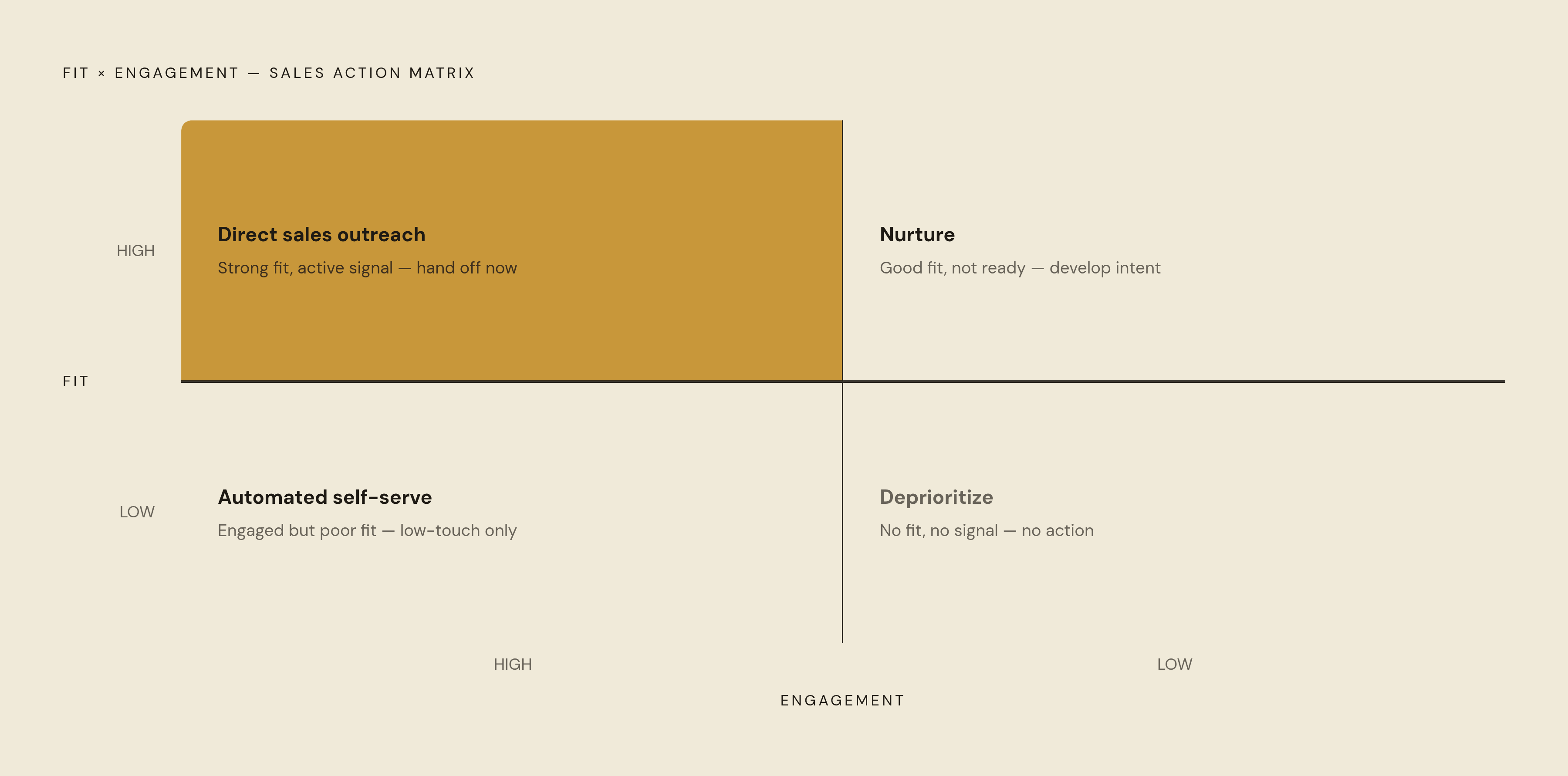
Each combination of scores needs an agreed operational response. A lead with high fit and high engagement goes straight to sales for direct outreach. High fit with low engagement triggers nurture designed to develop readiness. The account matches the target profile, but the contact has not yet shown enough intent.
Low fit changes the response even when activity is strong. A lead with high engagement below the fit floor should stay out of the sales queue and go into a low-touch automated sequence or self-serve path. Low fit with low engagement warrants deprioritization and no sales action. Klickbee’s guide states that every score band must trigger a specific action, with the MQL threshold agreed with sales and grounded in closed-won deals.
For buying committees, routing should take the whole account into account. A high-scoring contact supported by moderate engagement from other contacts presents a stronger signal than an isolated contact score. This places the interpretation of separate fit and engagement dimensions at the level where the buying decision occurs.
The handoff map is a joint operating agreement. It must spell out what happens before leads start arriving and require sales to give rejection reasons when it turns down an MQL. Those reasons supply the evidence for later adjustments to weights and thresholds. Without that agreement, the technical model merely postpones the original dispute about what qualifies.
When to start with a rules-based model and when to move to predictive scoring
The state of the data should carry more weight in choosing the scoring method than excitement about AI. A rules-based model is the appropriate starting point when converted-lead history is sparse, inconsistently captured, or poorly tagged in the CRM. It also provides a baseline for a first scoring program. When sales trust is low, transparent rules make qualification easier to understand and challenge.
Salespanel’s guide favors close manual control for lower-volume implementations. Predictive scoring becomes useful when a substantial history of converted leads includes consistently captured firmographic and behavioral data. Before that transition, the rules-based model should have been validated against closed-won deals and an established conversion baseline. Without that check, there is no trusted baseline to judge the more complex model against.
Hybrid scoring can preserve transparency while adjusting weights dynamically. It is appropriate when data volume supports machine learning and the team can manage retraining on a defined cadence. The same guide recommends quarterly retraining or retraining triggered by ICP, go-to-market, or product changes. Explainability remains essential throughout this progression because sales needs to understand which signals drove a score. Predictive scoring is therefore conditional on data and operating capacity.
Tooling options for implementing a two-dimension scoring model
Architecture should guide selection before platform preference does. The relevant requirements are separate fit and engagement scores, negative scoring, configurable decay, and score explanations visible to sales in the CRM. Product-led teams also need a connection to product analytics. Not every CRM-native option provides all these capabilities, so a broad scoring feature alone is not enough to establish suitability.
Ortto supports explicit and implicit attributes with separate weighting controls within a model. Its scoring documentation describes product events, including feature activations, invitations, and integration connections, as direct behavioral attributes. This makes it relevant to product-led and hybrid motions. HubSpot’s new Lead Scoring tool replaced legacy scoring properties with advanced logic, multi-model support, and explanations of contributing signals. It is relevant to teams already using the platform that want to consolidate tooling.
Salesforce Einstein requires a distinction between opportunity and lead scoring. Its Spring 2026 release expanded Opportunity Scoring to all Sales Cloud users at no additional cost. Lead Scoring is available through Sales Cloud Einstein, included in Performance and Unlimited Editions and available at extra cost in Enterprise Edition. Existing investment and edition therefore shape its suitability.
MadKudu, now part of HG Insights, provides predictive lead and account scoring for B2B SaaS fit and behavioral signals. It also focuses on product-qualified leads for product-led growth and high-inbound teams that have enough data. Salespanel’s guide describes its platform as supporting real-time omnichannel scoring across web, email, and CRM, with hybrid AI and rules-based approaches and explainability. Selection still depends on whether the implementation can enforce the model’s gate, corrections, and routing agreement.
Validating and recalibrating the model after it goes live
Calibration requires supplementing MQL volume with sales outcomes. Closed-won attributes should be compared regularly with the firmographic and behavioral signals receiving the highest weights. Divergence reveals where the model rewards the wrong characteristics or undervalues useful ones. Conversion rates for each score band then show whether qualified leads become SQLs and go on to close.
Sales rejection reasons provide an earlier diagnostic signal. Repeated objections can expose a weak fit floor, an overweighted behavior, or a threshold that no longer reflects readiness. These patterns need to shape the next calibration cycle, with the notes used to guide changes. A manageable number of scoring criteria makes that review practical, while excessive complexity makes the model difficult to audit.
Some changes should trigger review before the quarterly cycle. A significant ICP change, a new product or pricing tier, a major go-to-market shift, or a sudden SQL conversion decline in a previously reliable band all warrant recalibration. These are changes to the conditions under which the model was built. Leaving the rules untouched would preserve the old definition of qualification after its basis had shifted.
The feedback loop depends on reciprocal commitments from both teams. Sales must record why it rejects qualified leads, and marketing must use that evidence to adjust the model. When rejection reasons produce visible changes, sales has a reason to keep supplying them. When thresholds hold up against pipeline outcomes, marketing has a reason to defend MQL quality through quarter end.