Cold Email Personalization at Scale Without Manual Research
Automated signals replace manual research to personalize cold email at scale.

Cold email's volume-first model, send enough messages and a fraction will convert, has collapsed under two pressures arriving at once: inbox enforcement and prospect fatigue. Google and Yahoo started enforcing strict email authentication rules for bulk senders in February 2024. Regulatory exposure stacks on top: fines can reach $53,088 per email under CAN-SPAM, and €20 million or 4% of global annual turnover, whichever is greater, under GDPR.
The prospect side collapsed just as fast. Buyers now spot "AI slop," emails that feel custom but say nothing specific, within seconds. Template-level personalization now fails at the filter and at the human reading the subject line. Merge tags like {{firstName}} and {{Company}} register as automation noise, not attention.
What replaced volume-first is a model practitioners call relevant scale. The question that follows is mechanical rather than philosophical: how does automated signal-based personalization actually work?
What "signal-based personalization" means
A signal is a live account event, not a static firmographic field, and that distinction is the entire argument for why this approach outperforms manual research. A static company description or an eight-month-old funding round is not, because it carries no information about what's happening right now. Each functions as a timing indicator as much as a personalization hook. Intent data providers such as Bombora and Demandbase aggregate digital signals, including website visits, content downloads, search behavior, and product research activity, and these signals reveal which accounts are actively evaluating solutions before they've filled out a single form.
Timing is what makes a signal useful as a lever. AI SDRs built around this logic update personalization in real time against the latest company news and social activity, so that if a prospect's company announces a major initiative on a Tuesday morning, a Wednesday follow-up references it naturally before it goes stale.
Manual research cannot work at this resolution when you run a full pipeline. A sales development rep can realistically research and personalize somewhere between 15 and 25 emails a day if the work is thorough, and once a target market runs into the thousands, that ceiling makes signal-based depth impossible without automation. The second version takes a human writer real time to produce with care. AI tools can analyze thousands of signals in that same span, so what takes a salesperson hours gets handled in moments, at a volume no individual rep could sustain.
The three-layer framework that makes personalization both deep and scalable
Genuine personalization at scale rests on three layers working together: firmographic relevance, persona-based pain points, and behavioral or timing triggers. Skipping any one of them is why most "personalized" campaigns still read as generic, even when they clearly reference the prospect's company name.
The second layer is persona-based pain points, which tell you what this specific role cares about given that firmographic context. A VP of Engineering and a CFO at the same company face different problems even when the underlying company event is identical, so messages need to be tailored to the role, not just the account. Dynamic content extends this logic past the opening line: a prospect who recently browsed a pricing page might receive a follow-up built around ROI calculations or implementation timelines.
The third layer, timing and behavioral triggers, governs both what to reference and when to send it. Signals such as a recent job change, a hiring surge, or a spike in content engagement shape the message and its timing simultaneously, since a message triggered by a live event lands in a different cognitive context than one delivered on a fixed weekly cadence. Hyper-personalization draws on context data, behavior, intent, timing, to construct a genuinely unique opening line, while basic personalization simply inserts static data into a slot. Automated research tools can produce that level of specificity at scale, but only when all three layers are being fed continuously with fresh data, which is the problem the next stage of the system has to solve.
Building the data pipeline: how enrichment and segmentation feed the framework automatically
The three-layer framework works without manual research only if a data pipeline keeps every prospect profile current and sorts those profiles into the right template variant before a human opens the campaign. Dynamic logic tools such as Liquid Syntax let that enriched data populate templates conditionally, so if a field is missing for one prospect, that prospect doesn't see a visibly broken variable in the email.
Enrichment alone still produces generic copy if you don't pair it with segmentation. Granular segmentation is what turns an enriched list into targeted messaging, and the three-layer framework depends on combining segmentation with AI-driven data enrichment and dynamic template variables together, not as separate initiatives. Smaller, tightly segmented sends consistently beat large undifferentiated blasts on both deliverability and reply rates, which argues for narrower lists over broader ones even when the broader list looks more efficient on paper.
The pipeline connects to sequence infrastructure at the point where enrichment data becomes sequence variables. The strongest stacks pair a sequence tool with an AI personalization layer and CRM sync, so enriched data flows directly into the message variables and a prospect who replies or converts gets pulled out of the cold sequence immediately. Personalization has to extend through that entire sequence, continuing after the first send.
The sending infrastructure that keeps personalized outreach out of spam
None of the personalization work matters if the email never reaches a primary inbox. Domain setup, authentication, warmup, and volume management form the infrastructure layer, and it decides whether a carefully built message lands where the prospect will see it or disappears into a spam folder unread.
The primary company domain needs protection above all else: cold email automation should never run from it, because a single spike in spam complaints can damage domain reputation and spill over into transactional email delivery for the entire company. Most teams run three to five secondary domains, each carrying two to three inboxes, and rotate sends across them to stay under per-inbox volume limits and spread deliverability risk across the pool.
Authentication is no longer optional under current enforcement. Proper SPF, DKIM, and DMARC setup is a hard requirement under the 2024–2025 enforcement changes from Google and Microsoft, not a best practice to adopt when convenient. Automated warmup services and inbox rotation build and protect sender reputation before volume sending begins and while it continues, and warmup works together with validation so messages land in inboxes.
Volume ramping and list hygiene need ongoing attention, not a one-time setup. Personalized, signal-grounded outreach actually reduces spam complaints as a structural matter: a relevant email sent to a well-matched prospect draws far fewer complaints than a mass blast sent to a cold list, and spray-and-pray tactics now actively train spam filters against the sender while burning domains that took months to warm up properly.
Tools that handle signal research, personalization, and sending without stitching six platforms together
Choosing software for this system means weighing four criteria against each other: depth of personalization (does the tool reference real, timely account events or only firmographic fields?), scalability (can it run across hundreds of prospects without manual intervention per message?), deliverability (does it help emails land in the primary inbox?), and speed to send (how quickly can a rep move from identifying a prospect to sending a relevant message?).
Some tools are built around signal depth first. The learning curve is steep, but Clay's ceiling makes it a strong fit for technical SDRs who want full control over their enrichment and personalization logic.
Other platforms consolidate prospecting through sending into a single workflow. Snov.io combines cold email automation with prospecting and sales engagement in one platform, covering contact discovery, verification, AI-powered message creation, and sequence management, and carries a 4.5 rating on G2 with a free plan available for teams testing the workflow before committing. Apollo.io offers a database covering more than 240 million people and 30 million companies with direct dials and verified emails, paired with a built-in AI writer that generates personalized email variants and sequences spanning email and LinkedIn; its free tier works for testing a solo rep's early outbound work, and SMB and mid-market teams that want one system turn to this platform as a stitched-together stack alternative. Salesforge combines AI-driven personalization with email validation, unlimited warmup through Warmforge, and multilingual support, with its AI SDR agent, Frank, managing lead research, message creation, follow-ups, and meeting scheduling for teams that want automation covering the full SDR workflow.
A third group focuses on deliverability at high volume. Instantly's AI Sequence Writer generates complete multi-step sequences from a structured prompt covering offer, target audience, case studies, and number of steps, producing optimized subject lines and variable injection points for custom openers, backed by 600 ready-to-use templates as a starting scaffold.
A smaller category sits on top of a sending platform in addition to it. Sendspark adds AI-personalized video as a personalization layer, and a 30-second AI-personalized video can dramatically outperform text-only email; the platform handles sending, follow-up, and CRM sync around that video content and integrates with sequence tools like Outreach and SalesLoft.
Where most teams mis-spend their optimization effort
Most teams treat the opening line as the primary lever for reply rate and pour optimization effort into making the first sentence feel researched and personal. The evidence points elsewhere. A personalized opener grounded in real signals gets a prospect past their own pattern recognition, while what the email asks them to do shapes whether they actually reply. What the email asks the prospect to do carries comparable weight to how the email addresses them.
The 2025 Ultimate Cold Email Data Report found that an offer lifted reply rate substantially, that asking for a meeting cut reply rate sharply, and that social proof in the body added meaningfully to response. Most teams still spend the bulk of their optimization budget on the first line. So the opener earns the read, but the offer and the ask decide whether the prospect actually responds, and that reframes where testing effort belongs.
Let the signal-grounded content demonstrate that research was done, and don't reference the mechanism that produced it.
Follow-up sequencing is where most of the available replies go uncaptured. Top-performing sales teams use multiple touchpoints across channels to book a meeting with a cold B2B prospect, and cold email automation lets you build those touchpoints once, run them for every prospect, and branch based on behavior. Personalization needs to extend through that sequence: a prospect who opened an email without replying should receive a different follow-up than one who never opened it, making sequence branching a personalization decision.
AI has commoditized surface-level personalization to the point that it no longer differentiates a campaign on its own. The competitive advantage now rests in signal quality (how timely and specific is the event referenced), offer clarity (is there a reason to reply that doesn't require committing to a meeting), and sequence discipline. Signal-based personalization raises the floor on what counts as a credible email. Signals make the email credible, the offer and the ask make it actionable, and the follow-up sequence captures what the opener only started.
Building the system: a step-by-step workflow from signal to sent
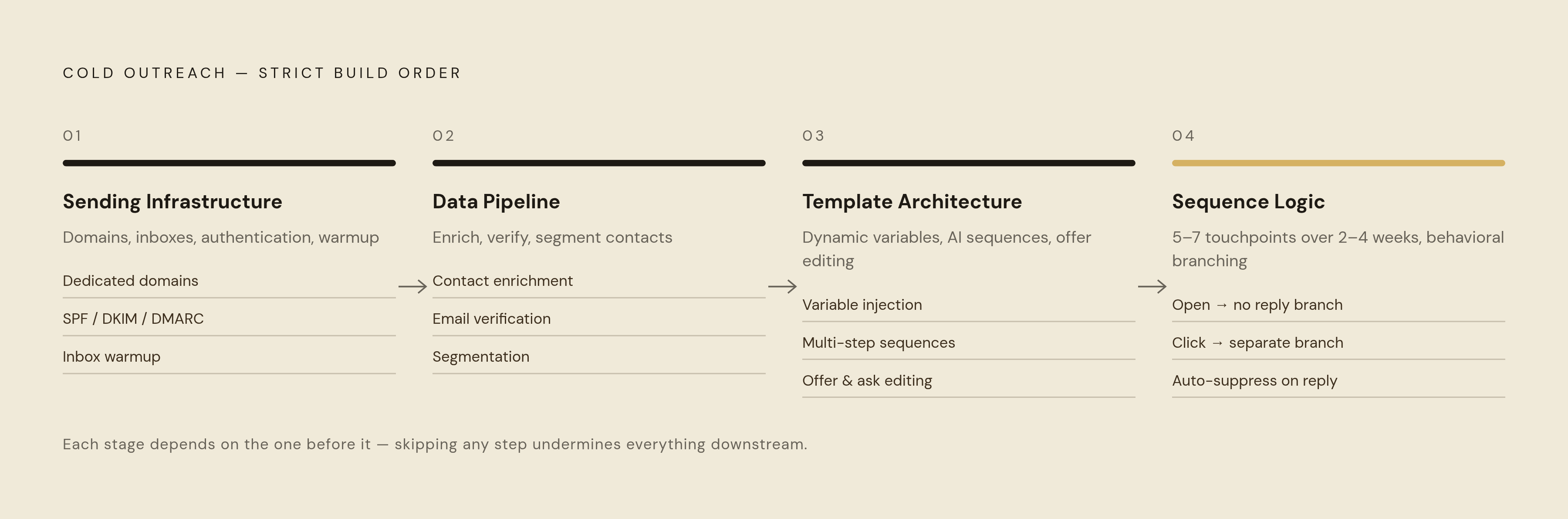
Putting all of this into practice means assembling four components in a fixed order: deliverability infrastructure first, then the data pipeline, then template architecture with dynamic variables, then sequence logic with behavioral branching. Each step depends on the one before it, so skipping ahead tends to undermine whatever comes later.
Sending infrastructure has to be in place before any volume goes out. Dedicated sending domains, never the primary company domain, multiple rotated inboxes per domain, DNS authentication through SPF, DKIM, and DMARC, and inbox warmup are the non-negotiable foundation, because the personalization layer has nothing to land on without it. Warmup should run for a defined period before sending at volume, with send counts ramped gradually so sender reputation builds organically.
Step two builds the data pipeline through enrichment and segmentation. Verifying contacts before they enter the sequence is what separates automation that books meetings from automation that burns through lists.
Step three is template architecture with dynamic variable injection. AI sequence writers can generate a full multi-step sequence from a structured prompt that covers offer, audience, and case studies, and you can use that output as a starting scaffold, editing it for offer clarity and ask structure before it goes live.
Step four configures sequence logic with behavioral branching. A working sequence runs five to seven touchpoints spaced over two to four weeks, with branching rules tied to prospect behavior: an open without a reply triggers a different follow-up than no open at all, and a link click triggers a different branch than a passive open. Personalization needs to extend past the first email, with each follow-up referencing the prospect's behavior, or lack of it, and escalating specificity rather than repeating the opener in slightly different words. Automatic suppression rules matter here too: any prospect who replies, bounces, or unsubscribes needs to exit the sequence immediately, both to protect sender reputation and to stay within authentication requirements.
Step five is measurement, iteration, and re-signaling. Lists need re-enrichment at regular intervals, because a trigger event that was timely three weeks ago has gone stale, so you need to re-segment or suppress prospects whose signals have shifted.
The system described across these five steps doesn't just dress up the volume-first model as another manual process. The aim was never to send more but to make each send count for more than the last one did.