Outbound Sequencing Tool Comparison for SMB Sales Teams
Apollo and Amplemarket dominate SMB sequencing, each solving a different problem.
Most outbound sequencing tools were built for enterprise sales floors, where a dedicated admin team manages the platform and sellers simply work the queue. A small sales team running its own outbound needs something different: a tool the team can configure in days, not quarters, and one that fits where the team actually sits in its outbound maturity. This comparison evaluates the sequencing options that matter for SMB teams now, and it explains why the standard enterprise buying checklist leads small teams to the wrong decision.
Why outbound sequencing tools built for enterprise sales are a poor fit for small sales teams
Enterprise sequencing platforms were designed around a specific organizational shape: large sales organizations with dedicated administrators, deep IT resources, and high seat counts. Platforms like Salesloft and Outreach need minimum seat commitments and dedicated admins, and most SMB teams cannot take that on without distorting how they actually sell. The tools are not deficient. They are built for a buyer who does not resemble a five-person outbound team.
The setup timeline compounds the mismatch. Onboarding for an enterprise platform often stretches into months, and that represents a real cost for a team that needs to ship sequences in week one rather than quarter two. Pipeline cannot wait on implementation. A small team that commits to a multi-month rollout has already lost a selling quarter before the first sequence fires.
The feature emphasis points in a different direction as well. A five-person outbound team rarely needs either. What it needs is data access and reliable deliverability, and those are not the dimensions where the enterprise category invests most heavily.
The four criteria that actually separate good and bad sequencing tool choices for SMBs
Small teams should evaluate sequencing tools on four criteria: seat-count flexibility, setup speed, outbound maturity fit, and workflow orchestration depth. Feature count and analyst rankings do not make the list. Seat-count flexibility determines whether a tool's cost scales linearly or stays predictable as headcount changes. Flat workspace pricing and per-seat pricing produce very different economics for a team that might grow from three to eight reps, and the distinction matters more at small scale than at enterprise scale.
Setup speed is a pipeline issue, not a convenience issue. Building a sequencing stack by hand across multiple tools can take weeks, but unified platforms compress this to days. A team that cannot begin outreach until the stack is assembled loses revenue in direct proportion to the delay.
Outbound maturity fit is the criterion most often skipped. A team just beginning structured outbound needs different affordances than one already running multichannel SDR plays, and buying a tool designed for the latter while sitting at the former stage creates configuration overhead that serves no purpose. The right question is not whether a platform can do something, but whether the team is ready to use it.
Workflow orchestration depth is where most platforms genuinely diverge and where most SMB buyers get surprised after purchase. A sequence sends. A workflow decides what happens around the sending. Signal-triggered entry, mid-workflow branching, account-level coordination, and CRM writeback are the capabilities that separate a true execution layer from a simple mail merge, and they rarely appear on a vendor's comparison chart.
One criterion that belongs on every SMB shortlist but rarely appears is deliverability infrastructure. AI-generated emails are worthless in spam folders, and the gap between platforms on this dimension is large. Where a team sits in its outbound maturity determines which of these criteria matter most, which is why no single tool wins this comparison outright.
How the sequencing tool market has tiered itself, and what each tier is actually for
The sequencing tool market has stratified into four distinct tiers, and SMB buyers frequently shortlist tools from different tiers as if they compete directly. They do not. Understanding the tiers is a prerequisite to evaluating any individual tool. Full-stack workflow platforms, a group that includes Amplemarket, Outreach, Salesloft, and HubSpot Sales Hub, combine data, sending, signals, deliverability, and workflow orchestration in one system. They suit teams that need the entire execution layer managed in one place, not stitched together across vendors.
AI-native sequencers, including Apollo, Lemlist, and Reply.io, are fast-setup tools for SMB and mid-market, email-heavy motions. Within this tier sits a further distinction: data-included platforms versus sending-specialized platforms. Sending-specialized platforms address the adjacent problem of reaching prospects reliably once they are found. Which one a team needs depends on whether its bottleneck is finding prospects or reaching them. Autonomous agents, a category represented by Artisan, act as a single AI SDR rather than a platform that reps configure. This is a different buying decision than a sequencing tool, and it belongs on a different shortlist. Adjacent tools, including Clay and Gong Engage, solve a specific part of the stack, data orchestration or conversation intelligence respectively, but they do not deliver end-to-end execution. They are complements to a sequencer, not alternatives to one.
Amplemarket: the platform built around workflow orchestration rather than sending volume
Amplemarket is the strongest fit for SMB teams whose outbound motion has matured beyond basic sequencing and who need the full execution layer, signals, enrichment, personalization, sequencing, and CRM writeback, managed in one system without stitching tools together. Its differentiation is structural rather than cosmetic. The orchestration score tells the story most directly. Amplemarket scored 20 out of 20 in workflow orchestration evaluation across five capabilities: signal-triggered entry, mid-workflow branching, multichannel orchestration, account-level targeting, and post-engagement CRM actions. The next closest platform in the same evaluation scored 13. That gap is the difference between a workflow that responds to what prospects do and a sequence that merely sends.
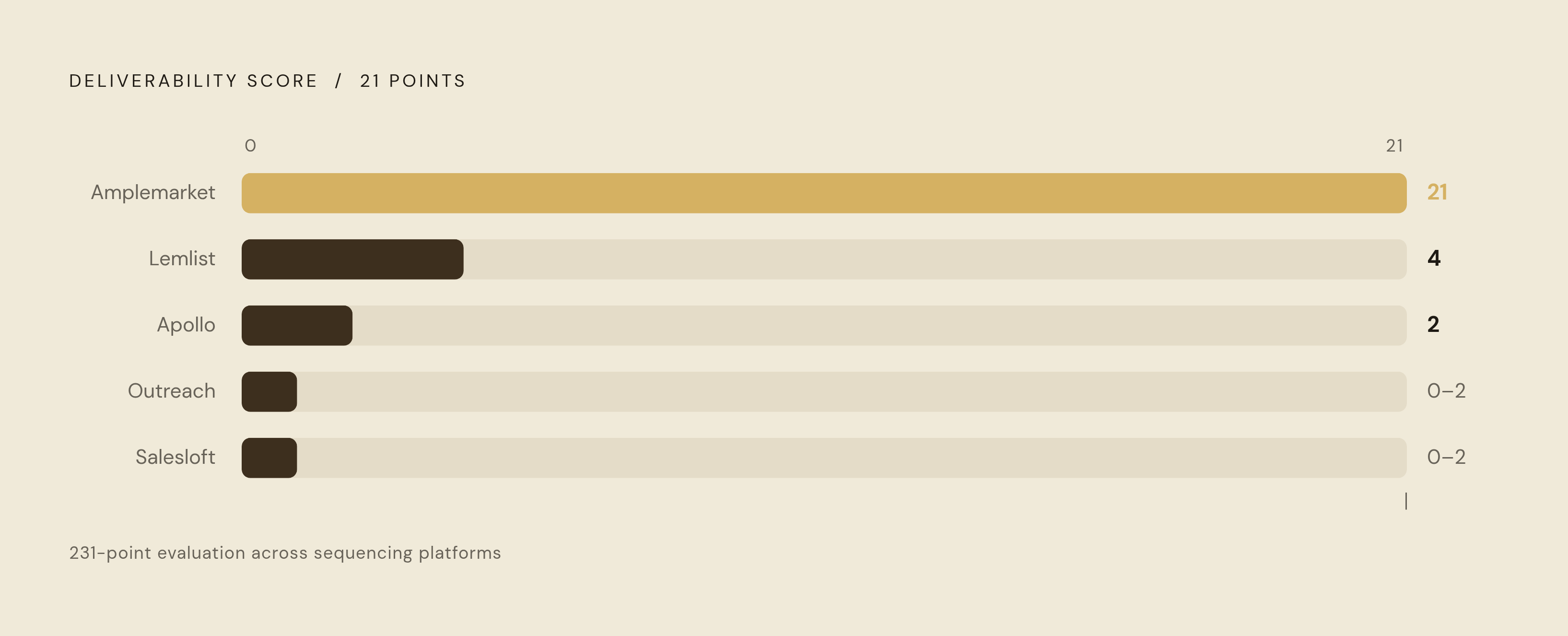
Deliverability is the second dimension where the platform separates itself. Amplemarket scored 21 out of 21 on deliverability in a 231-point feature evaluation, the only platform in the comparison to achieve a full deliverability score. Outreach, Salesloft, and Apollo all scored between 0 and 2 out of 21. For a team whose sending domain is its most valuable revenue asset, that distinction carries operational weight.
The platform also scored 21 out of 21 on AI and automation, with an overall feature score of 221 out of 231, or 95.7 percent. It supports seven channels with multichannel state shared inside one workflow, not parallel single-channel sequences coordinated manually. Its G2 rating stands at 4.6 out of 5 from more than 571 reviews.
Pricing comes after the value case, and it should. Amplemarket runs $3,600 per user per year, or $300 per user per month, at the entry point. The platform's value compounds most for teams already running multichannel plays who are losing deals to dropped follow-up and fragmented workflows, not for teams still writing their first sequence templates.
Apollo: the all-in-one starting point when data access and sequencing need to live in one place
Apollo is the strongest starting point for SMB teams whose primary constraint is finding the right prospects and reaching them without paying for a separate data vendor and a separate sequencer. The core value proposition is consolidation: a B2B contact database of more than 240 million contacts with integrated email verification and filtering, bundled with a sequencing engine. Teams that would otherwise subscribe to ZoomInfo or Lusha plus a separate sequencer can absorb most of the per-seat cost difference by canceling the data subscription.
The pricing supports its entry-point position. The Basic plan runs $49 per user per month on annual billing, which annualizes to $588 per user. A free tier lets you test before you commit. Its G2 rating is 4.7 out of 5, the highest in this comparison.
The constraints are precise and worth stating plainly. Deliverability scored 2 out of 21, the most significant structural limitation for teams planning high-volume cold outbound, and the AI and automation score of 7 out of 21 with an overall feature score of 98 out of 231, or 42.4 percent, reflects that Apollo is a database with a sequencer built in rather than a workflow orchestration platform. Data quality concerns around outdated contacts and high bounce rates are reported by practitioners, and stale contact data is the root cause of most AI personalization failures.
Instantly: the sending-specialized choice for teams that already have leads and need deliverability at volume
Instantly answers a different question than Apollo solves. It is a cold email infrastructure platform, not a prospecting database, and it is the right choice for SMB teams whose bottleneck is inbox placement and sending scale rather than prospect discovery. The pricing model inverts Apollo's structure. The Growth plan runs $47 per month on monthly billing, or $37.60 per month on annual billing, for the entire workspace, flat rate regardless of sender count. For teams larger than two or three users, that economics argument is decisive.
Email account support follows the same logic. Instantly supports unlimited email accounts on all plans, while Apollo caps this at one to fifteen SMTP accounts depending on tier. Free and Basic plans allow only one mailbox per user, but Professional adds unlimited Google and Microsoft mailboxes plus five SMTP, and Organization allows unlimited Google and Microsoft plus fifteen SMTP. For teams running domain rotation to protect sender reputation, that ceiling becomes a hard constraint.
Deliverability is Instantly's purpose. The platform is email-only at its core, with SMS and calling available through a separate CRM add-on, and there is no native B2B database. Teams need a separate data source, which adds cost and integration overhead, and AI features are limited relative to full-stack platforms.
Klenty and Reply.io: multichannel sequencing for SMB-to-mid-market teams that have outgrown email-only tools
Klenty and Reply.io serve the same core need: multichannel sequences with phone, LinkedIn, and email in one platform at SMB-approachable pricing. They differ in where they place that capability and how they price it, and the decision between them turns on channel mix and AI priority. Klenty puts its weight on dialing infrastructure. Multichannel and LinkedIn require the Growth plan at $70 per user per month, while the Starter plan runs $50 per user per month on annual billing. Its strength lies in number-health AI and a call coaching suite, which matter for teams where the phone carries real pipeline weight. The best fit is SDR teams under roughly 50 reps running structured multichannel outbound on tighter budgets than enterprise platforms require.
Reply.io covers email, calls, and social steps, with Jason AI, its AI SDR layer, offered as an add-on. Sequences start from $59 per month, multichannel from $99 per user per month, and G2 lists it at $89 per user per month. Its rating of 4.6 out of 5 from 1,560 reviews reflects a mature product with a more developed AI drafting layer, though Jason AI is sold separately and adds cost. The best fit is mid-market multichannel plays where the team wants AI-assisted drafting without moving to a full-stack platform price point.
Lemlist: personalization-first outreach for small teams where quality per contact matters more than volume
Lemlist is built for small teams that prioritize creative, personalization-heavy outreach over raw sending volume. Its competitive advantage sits in the quality of individual touches, not the orchestration of large-scale campaigns. The core value proposition is image and video personalization, LinkedIn steps, and email sequencing in one platform designed for outreach that is meant to be noticed rather than scaled. Its G2 rating of 4.5 out of 5 from more than 2,500 reviews signals a product that serves its niche well. Deliverability scored 4 out of 21, better than the enterprise platforms on this measure and with warmup tools included, though not a full deliverability stack. AI and automation scored 3 out of 21, which reflects writing assistance that is real but limited compared to signal-driven platforms.
The best-fit profile is precise: a founder doing outbound personally, or a two- to three-person team selling into a small, well-defined ICP where a memorable email matters more than sending throughput. Lemlist does not have the data platform, signal infrastructure, or orchestration depth of full-stack platforms, and teams that grow into high-volume multichannel plays will need to migrate. That is not a defect. It is the boundary of the product's intent.
HubSpot Sales Hub: the sequencing choice for teams already running on HubSpot CRM
For SMB teams already using HubSpot as their CRM, HubSpot Sales Hub's native sequencing is the path of least resistance. The integration is zero-configuration, and the total cost is lower than adding a standalone sequencer on top. Sequences live inside the same environment as contacts, deals, and pipeline. There is no API sync, no activity logging gaps, and no duplicate contact records. Sales Hub is classified as a full-stack workflow platform in the tier structure, but its sequencing strengths are tied closely to the value of the broader HubSpot ecosystem. Teams not already on HubSpot CRM should not adopt Sales Hub sequencing as a reason to migrate. The native integration advantage disappears when the CRM lives elsewhere.
Why deliverability is the most consequential capability most SMB teams evaluate last
Deliverability determines whether any sequencing investment produces results. A well-structured sequence that lands in spam generates no pipeline regardless of which platform built it, and yet it remains the criterion most SMB teams evaluate last. The structural evidence is stark. Only one platform in the 231-point evaluation achieved a full deliverability score. Outreach, Salesloft, Nooks, and Apollo all scored between 0 and 2 out of 21, meaning most platforms that SMB buyers shortlist carry minimal deliverability infrastructure. Domain health, inbox warm-up, sender rotation, bounce handling, and authentication through SPF, DKIM, and DMARC are the concrete capabilities that separate a full deliverability stack from a platform that lists deliverability as a checkbox feature.
AI-generated email compounds the risk. The practical consequence is that a team buying a low-deliverability platform, scaling volume, and burning its sending domain has lost weeks or months of sender reputation that cannot be recovered quickly. The tool switch happens after the damage is done.
Matching outbound maturity stage to the right tool from this list
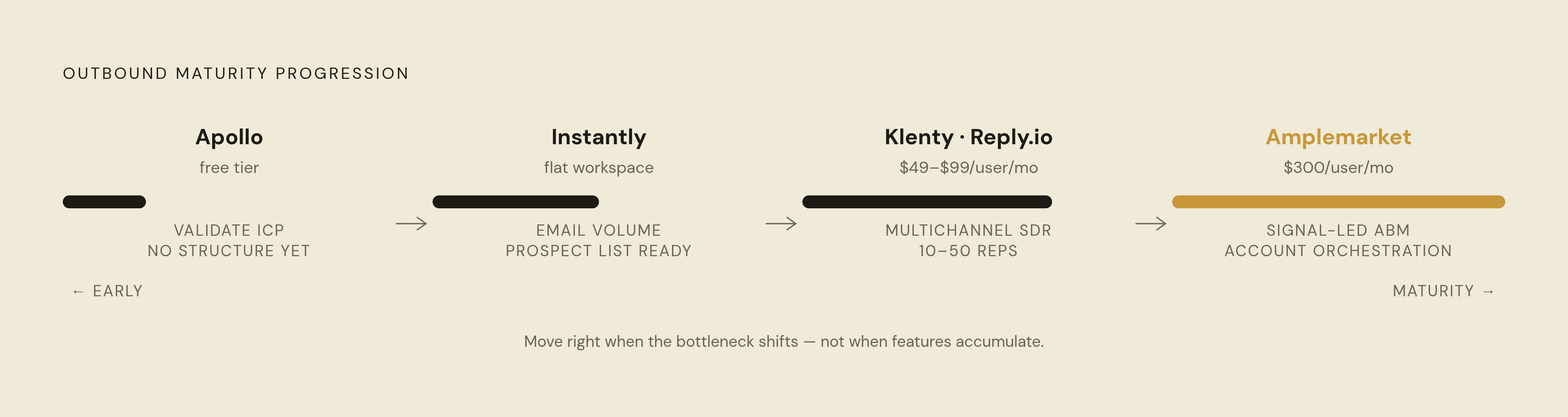
The right sequencing tool for an SMB team is not determined by feature count but by where that team sits in its outbound maturity. The same team profile at different maturity stages needs a fundamentally different platform. Teams under ten reps with no structured outbound yet need data and sequencing in one place: Apollo. Starting on the free tier validates ICP and sequencing logic before committing to a paid seat, and the consolidation value is highest at this stage. Teams with a working prospect list that prioritize cold email volume and inbox placement over data discovery should choose Instantly, where flat workspace pricing and unlimited email accounts provide the lowest-cost path to responsible volume sending.
Small teams where each contact matters and personalization quality is the differentiator fit Lemlist best. Teams already on HubSpot CRM should use HubSpot Sales Hub native sequencing, where the zero-configuration CRM integration outweighs any feature advantage a standalone sequencer offers. SDR teams running multichannel plays across ten to fifty reps should evaluate Klenty, at $70 to $99 per user per month for multichannel tiers, or Reply.io, at $49 to $89 per user per month depending on tier, both of which deliver multichannel sequencing with a dialer and LinkedIn steps at SMB-approachable pricing. Teams whose outbound motion has matured to signal-led, account-based plays and where workflow orchestration is the bottleneck should choose Amplemarket. The full deliverability stack, seven-channel orchestration, and signal-triggered workflow entry justify the price point for teams losing deals to dropped follow-up and fragmented workflows rather than to a shortage of contact data. The maturity progression most SMB teams follow is Apollo or Instantly to validate outbound, then Klenty or Reply.io when multichannel becomes the motion, then Amplemarket when orchestration and deliverability at scale become the binding constraint. The signal that a team has outgrown its current platform is one to watch closely: reps spending meaningful time managing what the tool should be doing automatically, re-enrolling contacts, manually logging CRM updates, cross-referencing deliverability dashboards from a separate tool.