Deliverability Impact of Sending Infrastructure Choices in Cold Outreach Tools
Choosing the right sending infrastructure matters more than message copy for email deliverability.
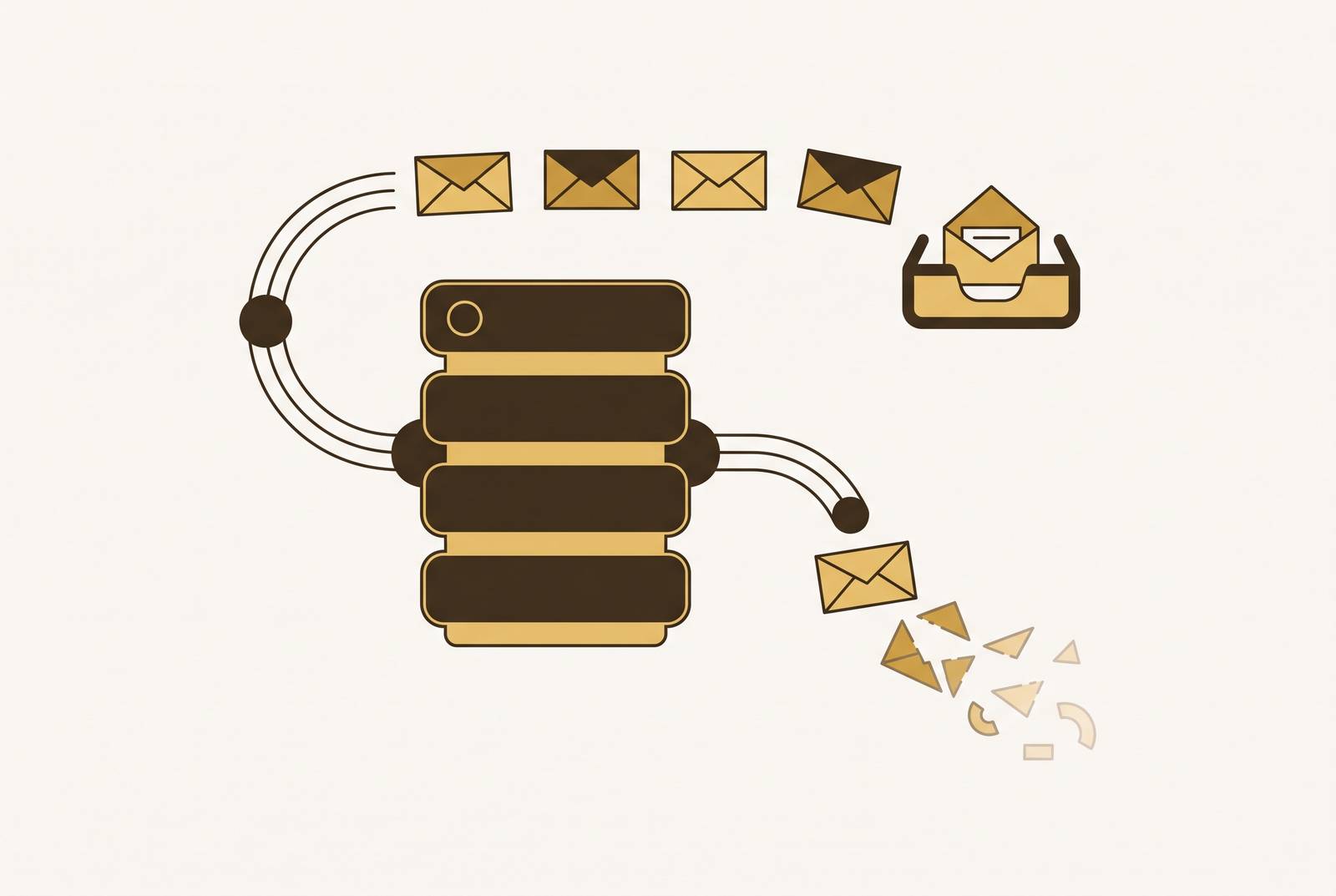
Cold outreach deliverability depends on both the message itself and the sending infrastructure behind it. Domain separation, authentication, provider choice, warmup, sending behavior, and monitoring form a layered system controlling delivery to the inbox, placement in spam, or disappearance without reaching the recipient. These decisions compound, and strength in one layer cannot repair failure in another.
Why cold outreach deliverability is an infrastructure problem, not a copy problem
A RevOps lead’s reply rate more than halved over 18 months even though the copy, ideal customer profile, and sequencer had not changed. The sending infrastructure had quietly degraded. That case exposes a common diagnostic error, which is treating declining responses as evidence that the message needs rewriting. When the failure sits earlier in the delivery path, changing the copy leaves its cause untouched.
For the same reason, campaigns with the same copy and similar list quality can have very different results on different infrastructure. Even a well-written message cannot get past a server-level rejection. A strong offer also does little to draw attention to an email buried in spam. A misconfigured domain can also damage every inbox attached to it, extending the consequences beyond a single campaign.
How mailbox providers now evaluate senders before any content is judged
Mailbox providers check domain authentication, IP reputation, sending patterns, and engagement history before they begin content filtering. These are separate checks with connected consequences. The MUA, MSA, and MTA model distinguishes the mail user agent, mail submission agent, and mail transfer agent layers. Authentication at the MSA layer establishes technical legitimacy, while weaknesses elsewhere in the path can still undermine delivery. Passing authentication is permission to be evaluated.
Gmail and Microsoft use behavioral AI to assess how recipients across thousands of inboxes interact with mail from a domain. Their enforcement has also become less forgiving. Gmail began moving beyond soft delays to temporary and permanent rejections for non-compliant senders in November 2025. Microsoft introduced outright rejection for non-compliant high-volume senders reaching Outlook.com, Hotmail.com, and Live.com addresses on May 5, 2025, covering senders at 5,000+ emails/day. Crossing the high-volume threshold even once can permanently bring a sender under stricter bulk-sender treatment.
Why the primary domain must stay out of cold outreach entirely
Because providers evaluate domain-level reputation, cold outreach from the primary business domain exposes unrelated business mail to the same risk. In one practitioner example, reputation damage sent the CEO’s customer emails to spam and prevented finance from reliably delivering invoices. Transactional email and internal communication should not depend on the reputation of an unsolicited outreach campaign. Separating the sending domains contains that exposure.
The practical rule is to use secondary domains that remain visibly connected to the brand, such as getyourcompany.com or tryyourcompany.com. Reputable TLDs including.com,.io, and.net are preferable to names with hyphens, numbers, or a disposable appearance. Each secondary domain should support no more than two to three dedicated mailboxes, with modest daily sending limits. Capacity should grow through additional secondary domains. With this setup, a drop in one domain’s reputation leaves other domains able to send.
Separation is not a permanent shield against degradation. Secondary domains accumulate reputation baggage too, which supports proactive rotation every 6–9 months even when nothing appears broken.
What authentication records actually do and why all three are now mandatory
SPF, DKIM, and DMARC address distinct parts of authentication, so configuring one does not remove the need for the others. SPF uses a single TXT record to identify the mail servers authorized to send for a domain. Multiple SPF records or excessive lookups can cause soft or hard failures. DKIM instead applies a cryptographic signature to outgoing mail. The sending provider generates the keys, and the domain publishes the public key in a TXT record so that the signature can be verified.
DMARC adds the domain’s authentication policy to this setup. A malformed record can undermine delivery even when the rest of the configuration appears complete. Alignment is another independent requirement. Gmail expects the visible sender domain to align with either SPF or DKIM, so individually valid records do not necessarily produce an acceptable result. All three should be part of the basic setup, though the rules enforced now differ from the stricter DMARC policies providers are moving toward.
Authentication errors can also become visible during warmup when messages land in spam within the warmup pool. That is a diagnostic signal. Detection is not guaranteed within days, and failures can remain present for weeks before they are noticed. Warmup therefore offers an opportunity to uncover a broken configuration before campaign volume magnifies its consequences.
How the choice of sending infrastructure — shared IP, dedicated IP, or native provider — shapes reputation from day one
Once authentication is correct, the sending environment determines which reputation the sender inherits or must build. Native provider mailboxes such as Google Workspace and Microsoft 365 send through established provider IPs and operate within those providers’ ecosystems. They are reliable B2B cold email infrastructure when paired with proper authentication and controlled behavior. Their filtering is not identical, however. Google evaluates sending behavior more dynamically and aggressively, while Microsoft’s enforcement is more predictable but tightened with its May 2025 rule change.
With shared IP infrastructure, users share a reputation. It is generally cheaper and faster to launch, and an established pool avoids the need to warm a new IP from zero. The provider keeps the pool clean, and good behavior from other senders in the pool can soften the effects of small errors. The reverse is equally important. Bad behavior from others on the IP can hurt delivery even for senders who follow good practices, so the quality of the pool is part of the risk they take.
A dedicated IP isolates reputation and gives the sender control, but it begins without an established history. Unknown IPs face more aggressive filtering. Without a large volume of mail each month, there may be too little engagement to keep a reputation steady, so a clean shared pool can be the better choice. Every error also belongs to the dedicated sender, without neighboring good behavior to soften it. For agencies, client isolation can nevertheless justify dedicated infrastructure because shared-pool blacklisting can affect multiple clients simultaneously.
What warmup actually does to sender reputation and where it fails
Warmup builds engagement history for a sending address over time through opens, replies, and spam-folder rescues. It does useful work after authentication is correct. A properly authenticated but unwarmed mailbox can still underperform a warmed one, particularly when sending volume rises before a credible history exists. For new domains, the supported approach is a multi-week ramp from a low daily count, with placement tests determining the pace. Keeping warmup active between campaigns maintains that activity.
Small warmup networks that reuse the same accounts can create patterns in when activity happens that Gmail and Outlook are getting better at spotting and discounting. Reading time also receives weight, so a fraction-of-a-second bot open can be worse than no open. Warmup is therefore neither optional magic nor a substitute for technical legitimacy. It cannot repair broken authentication or neutralize complaints from actual recipients.
Tracking infrastructure creates a related reputation dependency. A branded CNAME keeps tracking links on the sender’s own subdomain rather than a default domain shared with other senders. That separates the tracking domain’s reputation from those other users, but it does not remove the need for disciplined sending.
How sending behavior and list hygiene determine whether built reputation holds
Reputation depends on what happens after launch. Spam complaints, invalid recipients, and sudden volume increases can erode it even when the initial setup was correct. For bulk senders, complaint rates are enforcement thresholds. Going over provider limits can lead to throttling, spam placement, or rejection. Those outcomes can hurt a sender however much warmup has been done.
List hygiene directly affects this feedback loop because hard bounces tell providers that the sender is targeting invalid addresses. The operational response is to verify every address before sending and remove role accounts, obvious typos, and catch-all risks. Hard bounces and persistent soft bounces also need ongoing suppression. Validation is not a one-time import task. Without continued removal, a clean starting list can still become a source of reputation damage.
Providers can interpret rapid acceleration as compromised infrastructure or the use of purchased lists, even on warmed domains. Spreading controlled volume across secondary domains means less depends on the reputation of any one domain. Short, plain-text emails without tracking pixels can also reduce content signals that filters weigh, supporting sound infrastructure through sending behavior. Whether these controls are working must be established through delivery signals.
Monitoring signals that reveal infrastructure degradation before reputation is lost
Inbox placement rate is the primary monitoring signal, followed by spam complaint rate and bounce rate. Open rate is a weaker diagnostic measure. Apple Mail Privacy Protection and similar features distort it, so apparently healthy opens do not establish healthy delivery. Teams should run placement testing before they raise campaign volume so they can check authentication and warmup before sending to more live recipients. Checking every week then helps teams see what changes as they send.
Blacklist checks give teams another way to check the health of their infrastructure before and during campaigns. Not all lists have equal influence. Some have negligible effects, while major listings can damage delivery with major providers. Tools for this monitoring work include sender-health dashboards and email deliverability testing services. Their place in the operating model is to replace assumptions about sender health with observable signals.
Instantly puts inbox placement testing, blacklist monitoring, and warmup in a single dashboard, so teams have less to coordinate across client domains. Automatic suspension is the complementary control. Bounce-rate and complaint-rate thresholds should trigger a sending pause before a deteriorating domain crosses provider enforcement limits. A shared-IP incident still needs attention for every client at risk, so teams must plan monitoring and reputation isolation together.
How each infrastructure layer compounds on the others to produce a final placement outcome
A warmed mailbox on an unauthenticated domain can still land in spam because engagement history does not override authentication failure. A correctly authenticated domain without an established sending history can attract scrutiny when volume spikes. Clean configuration is not protection from dirty lists. Complaints and bounces can destroy the reputation that careful setup and warmup were intended to support.
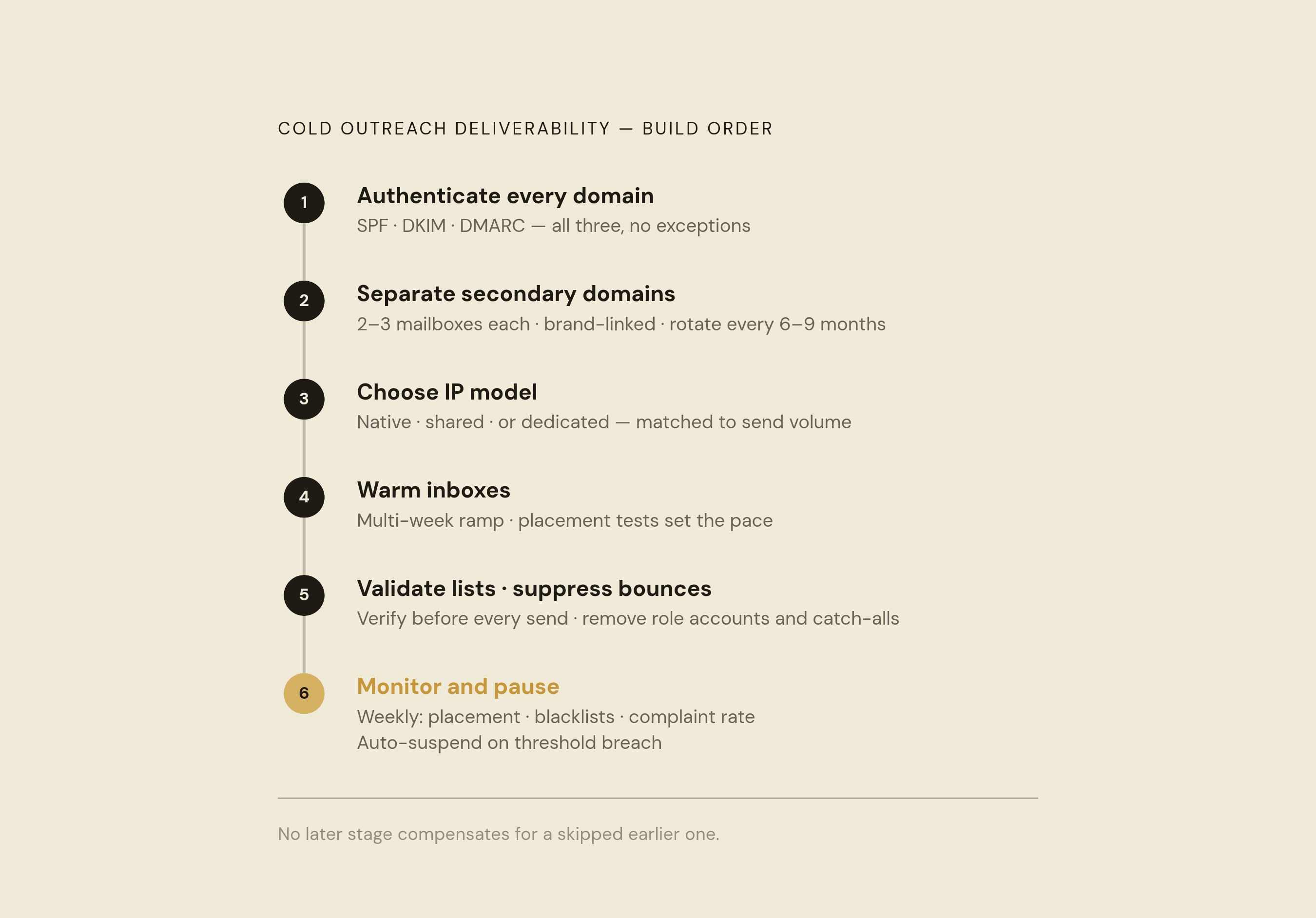
The RevOps lead’s recovery followed those dependencies, addressing authentication first, then the domain, inbox, and daily-cap structure, then list quality and monitoring. That sequence gave later changes a sound foundation. Fixing list quality alone would not have corrected an authentication failure, just as repairing authentication would not have stopped complaints from poor sending practices. The practical build order is to authenticate every domain, establish secondary-domain separation, choose an IP model suited to volume, and warm the inboxes through a quality network. Teams then need to validate addresses before sending, monitor every week, and pause when thresholds are reached.
Monitoring can expose a weak layer, but it cannot make that layer healthy without a corresponding change. Provider infrastructure can supply an established reputation environment, but sending behavior determines what happens within it. Infrastructure is the compounding variable because each layer changes how effectively the next one can work, allowing disciplined operation to build durable reputation while neglect spreads damage through the stack.