Task Prioritization and Daily Workflow Design for High-Volume SDRs
Structure your day around intent-ranked tasks to reclaim time for selling.
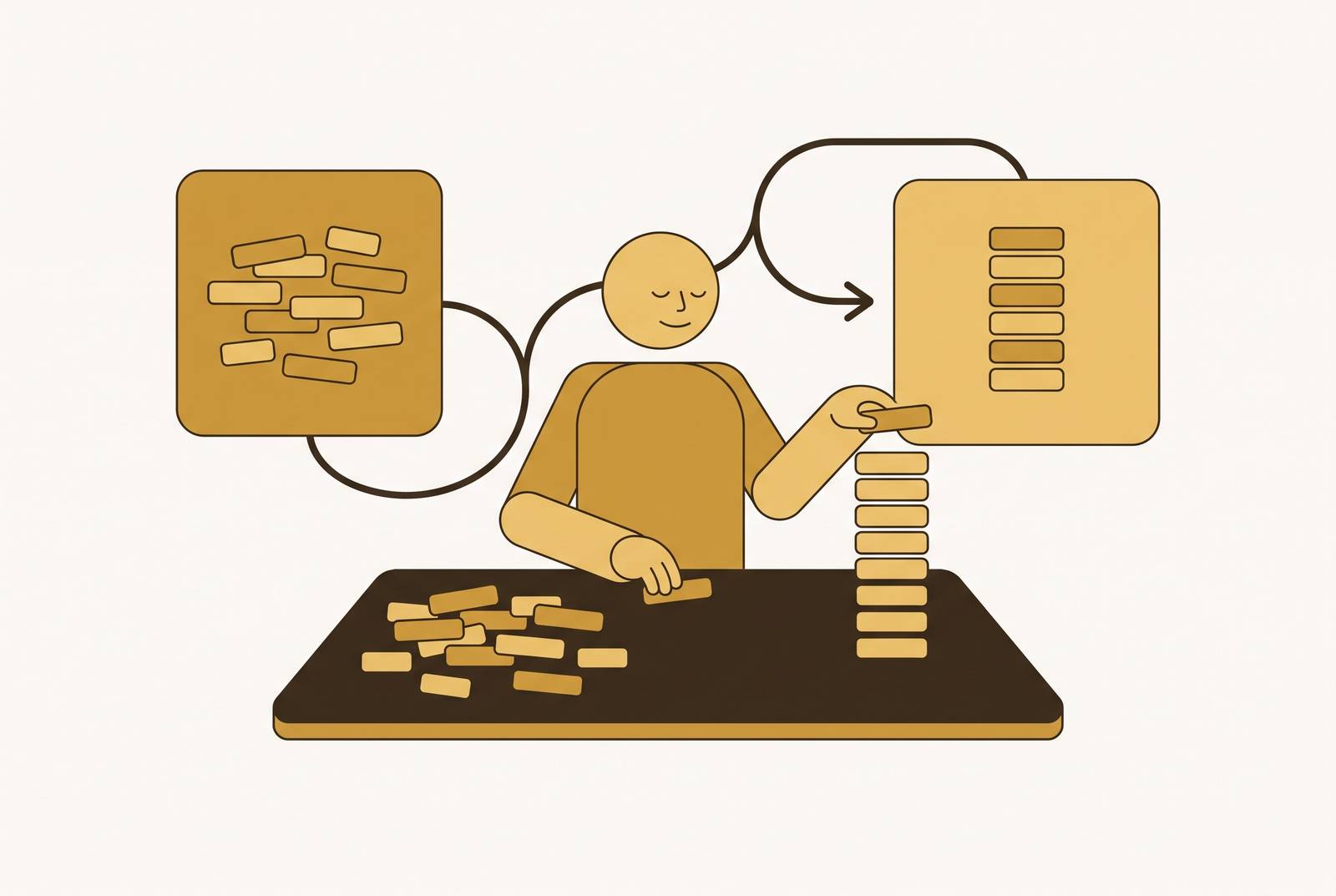
High-volume SDR performance depends on task prioritization and daily workflow design. Chronic underperformance is a structural failure when the day demands more research, coordination, and administration than selling. A daily system can rank work by intent, set aside time blocks for high-value activities, and automate preparation while leaving people to use their judgment in conversations.
Why high-volume SDRs underperform even when they work hard
The morning starts with an intent dashboard, moves to the CRM, branches into LinkedIn, and ends in an email sequencer before the first call happens. A dozen or more tabs remain open as the SDR copies information between systems that do not talk to each other. Every transition demands another decision about what matters and what to do next. By the time outreach can begin, decision fatigue has consumed part of the morning’s most valuable window.
This is how a busy day becomes an unproductive one. Research, email drafting, CRM entry, and internal meetings take more time than selling conversations, leaving the ratio badly inverted. Some reps work harder and manage that imbalance better, but exceptional discipline is not a scalable operating model. A system that depends on willpower to keep calls from scattering across the day is fragile by design.
How tool fragmentation quietly steals the highest-value hours
The cost of fragmentation is slower work and the diversion of the SDR’s most cognitively available hours into administrative archaeology, precisely when executive decision-makers are reachable. An intent dashboard surfaces a warm account, but the CRM contains incomplete notes from a colleague’s call six months ago. LinkedIn opens five more tabs, and the email sequencer needs a new thread. The result can be one hour, one account, and zero outreach completed.
Intent data can deepen this problem when it provides information without a next action. Third-party intent that says “Acme Corp is researching your category” still leaves the rep to find a contact, select a channel, write a message, and log the activity. By contrast, “John Smith, VP Sales, visited your pricing page twice yesterday — direct dial included” collapses the research loop. The distinction is between an account worth investigating and a person ready to contact. A workflow that treats both as finished leads hides the work still needed to prepare them in the queue.
The remedy is a workflow in which each signal surfaces a single next action. That removes the tab tax at the point where it interrupts selling. Across a team, hours lost to coordination otherwise accumulate into selling capacity that exists on the payroll but never reaches prospects.
What intent-weighted prioritization actually does to a task queue
A static playbook assigns priority through broad rules such as “call inbound first.” An intent-weighted queue instead ranks tasks by behavior, including page visits, repeat opens, email replies, and meeting page views. Those rankings change in real time as engagement goes up or down. The SDR starts with an ordered set of actions rather than dashboards that still need interpretation.
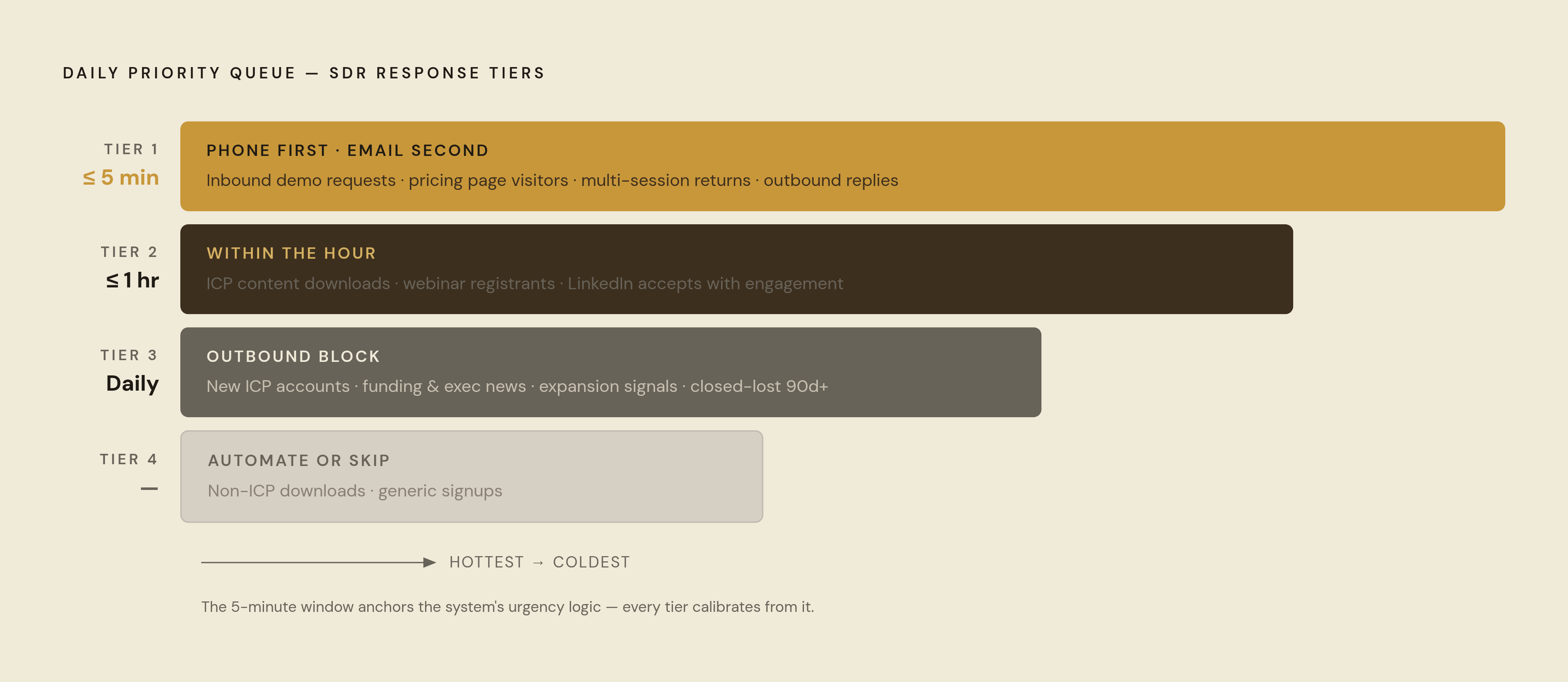
Tier 1 is the same-day phone-call tier, with a response target within five minutes. It covers inbound demo requests, pricing page visitors, return visitors who have had multiple sessions, and replies to outbound sequences. Phone is the first channel, with email second. This tier directs immediate attention toward prospects whose behavior gives the rep a concrete reason to reach out.
Tier 2 calls for action within the hour on content downloads from ICP-fit companies, people who register for a webinar, and LinkedIn connection accepts from profiles that have engaged. Tier 3 belongs in the daily outbound block and includes new ICP-fit accounts, funding, executive hires, expansion news, and closed-lost accounts ready for re-engagement after ninety-plus days. Tier 4 contains non-ICP downloads and generic newsletter signups, which should be automated or deprioritized.
The queue sends effort toward momentum that already exists before spending it on colder opportunities. Warm accounts contacted through intent-informed prioritization convert at a meaningfully higher rate than cold outreach.
The time-blocked daily schedule that makes prioritization stick
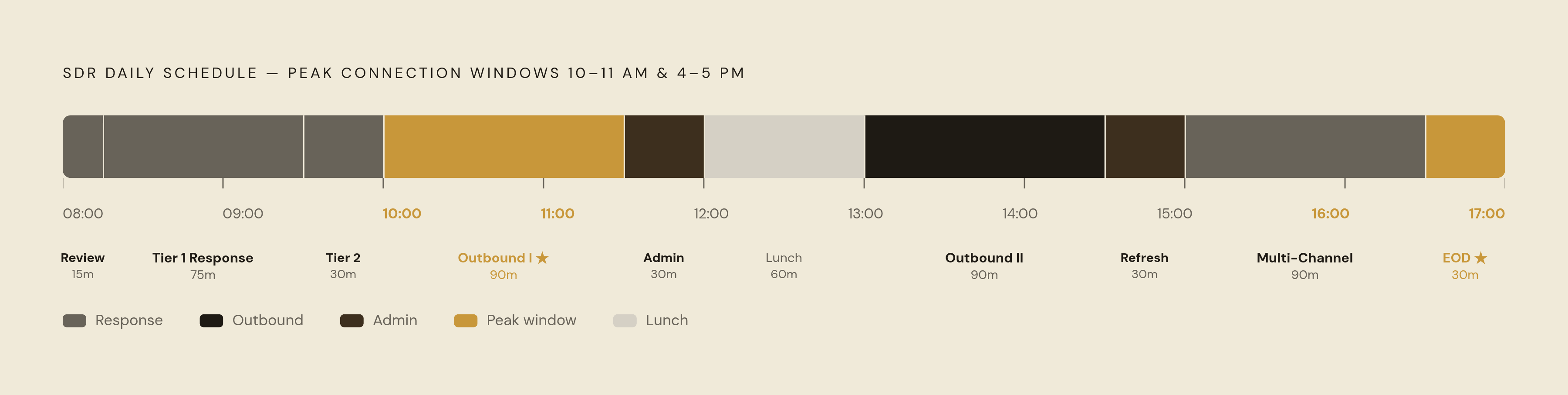
An accurate queue still needs protected execution time. Without it, the first distraction can turn ranked work back into reactive task-switching. The schedule must therefore contain routine work without delaying urgent responses. Tier 1’s five-minute target and Tier 2’s within-the-hour target remain response rules that apply even outside the designated block.
08:00–08:15 is playbook review. The rep reviews overnight inbound, email replies, and new intent signals, with the hottest leads already ranked. 08:15–09:30 is Tier 1 response and hot leads. Reps respond to demo requests and pricing page visitors right away, by phone first and email second. Context is pre-loaded so this window goes to contact.
09:30–10:00 is Tier 2 follow-up. This block also has time for yesterday’s conversations, voicemails, and LinkedIn touches. 10:00–11:30 is the first outbound prospecting block. Tier 3 cold calls, personalized emails, and LinkedIn engagement belong here, with each focused block kept to one type of work. 11:30–12:00 is admin and prep, containing CRM logging, sequence updates, and the afternoon list build.
13:00–14:30 is the second outbound block. Afternoon calls need to account for the lunch slump during 12–2 PM, rather than assuming every hour offers the same chance of connection. Calls are more likely to connect in late morning, 10–11 AM, and late afternoon, 4–5 PM. 14:30–15:00 is the mid-afternoon playbook refresh, when new inbound and replies change the order of remaining work. 15:00–16:30 is multi-channel follow-up, with time for LinkedIn engagement, video prospecting, and social selling.
16:30–17:00 is end-of-day review. Remaining activities are logged, tomorrow’s priority list is set, and issues needing manager attention are flagged. The five minutes devoted to tomorrow’s ranked list are especially valuable because they prevent the next morning from opening with an empty dashboard. Admin time is similarly non-negotiable.
The blocks protect concentration as well as availability. A rep who interrupts a calling block to draft an email must rebuild the conversational mindset on returning to the phone. Daily conversation targets also need to reflect the dialing method, since manual dialing targets fewer live conversations than parallel dialing.
Which parts of the workflow to automate and which to keep human
The CRM should enter data and log activity for calls, emails, and meeting notes automatically. Research and enrichment should build account briefs ahead of time, while scoring ranks tasks by intent, ICP fit, and engagement history. These tools clear the preparation queue that would otherwise take up the start of the day.
Scheduling can also run in the background through calendar links, round-robin routing, timezone detection, and confirmation emails. Follow-up reminders and data hygiene, including bounced emails, job changes, and champion tracking, belong there too. AI can produce first-draft personalization from real signals, leaving the rep to edit. Automating the draft does not remove the need to judge whether the message is credible.
Discovery calls, demos, and live objection handling stay with people because they need to adapt as they go. “We're not ready” and “we're evaluating competitors” require different responses. Deep research to plan an approach to top enterprise accounts also calls for judgment about how the company works, its real pain, and the right entry point. Relationship building needs genuine personal context that an automated message cannot credibly supply.
The fully autonomous AI SDR argument deserves a fair distinction between meeting volume and meeting quality. Many early fully autonomous pilots were paused or shut down soon after they began, while pure-AI programs without human handoff led to more meetings but much lower meeting-to-opportunity conversion. John Barrows argues that the SDR role was hollowed out by turning reps into high-volume email machines while neglecting business acumen, curiosity, and emotional intelligence. His position supports intentional automation. The dividing line is clear, with the system handling research, sequencing, routing, and scheduling, and people handling conversations and strategic judgment.
The signal literacy that separates SDRs who use the system from those who are threatened by it
Working well inside this structure requires signal literacy. A named person visiting a pricing page is a first-party signal ready for a call, while a company researching a category through third-party intent is ready for research. A single email open is noise compared with repeated opens accompanied by a link click. A skilled rep knows why those differences change what to do next.
Job postings that signal expansion, funding announcements, executive hires, and G2 review activity can supply a reason to contact an account. The rep’s task is to translate that reason into a relevant first message and refine AI-generated copy so it reflects the actual signal. Clean CRM data then feeds back into tomorrow’s ranking to improve it, tying the work of keeping records to selling.
This is where business acumen and automation reinforce each other. Reps who interpret signals intelligently improve both their own decisions and the information the system receives. Mastery belongs to the SDR who operates the system and applies judgment to the live conversation, the real objection, and the enterprise relationship.
Building the system: the prioritization and workflow stack that supports this structure
The daily structure requires four connected layers. The first is ICP definition and qualification logic embedded upstream, including firmographic filters, buying signals, exclusion rules, and disqualification criteria. These rules belong in routing before leads reach a rep’s queue. Without negative criteria, reps spend time on accounts that will never close.
The second layer is the task queue ranked by intent that arrives each morning. Its scoring model weighs ICP fit, engagement signals, and trigger events so the rep executes a prepared list. The third layer is background automation for CRM logging, enrichment, sequence management, meeting scheduling, and data hygiene. Together, these upstream tasks can return two to three selling hours per day to the rep.
The fourth layer is a quality assurance loop each week in which the team reviews calls, looks at objections and how sequences performed, and builds the list for the next week. Without feedback, the system drifts and the ranked list loses accuracy. Missing any layer forces the rep to compensate with the same willpower the structure was meant to replace.
Valley fits this architecture as an AI-assisted outbound workflow layer for lead prioritization, personalized outreach generation, and LinkedIn-first outbound sequencing, with email as an optional add-on. Its role is to connect signals to tasks and manage the outreach sequence while the human rep concentrates on conversations.
The north-star metric is held meetings. The benchmark is roughly fifteen meetings booked per month with a high show rate, yielding approximately twelve held meetings. The objective is more pipeline from the team already in place. Achieving that is a team-level investment in workflow design.